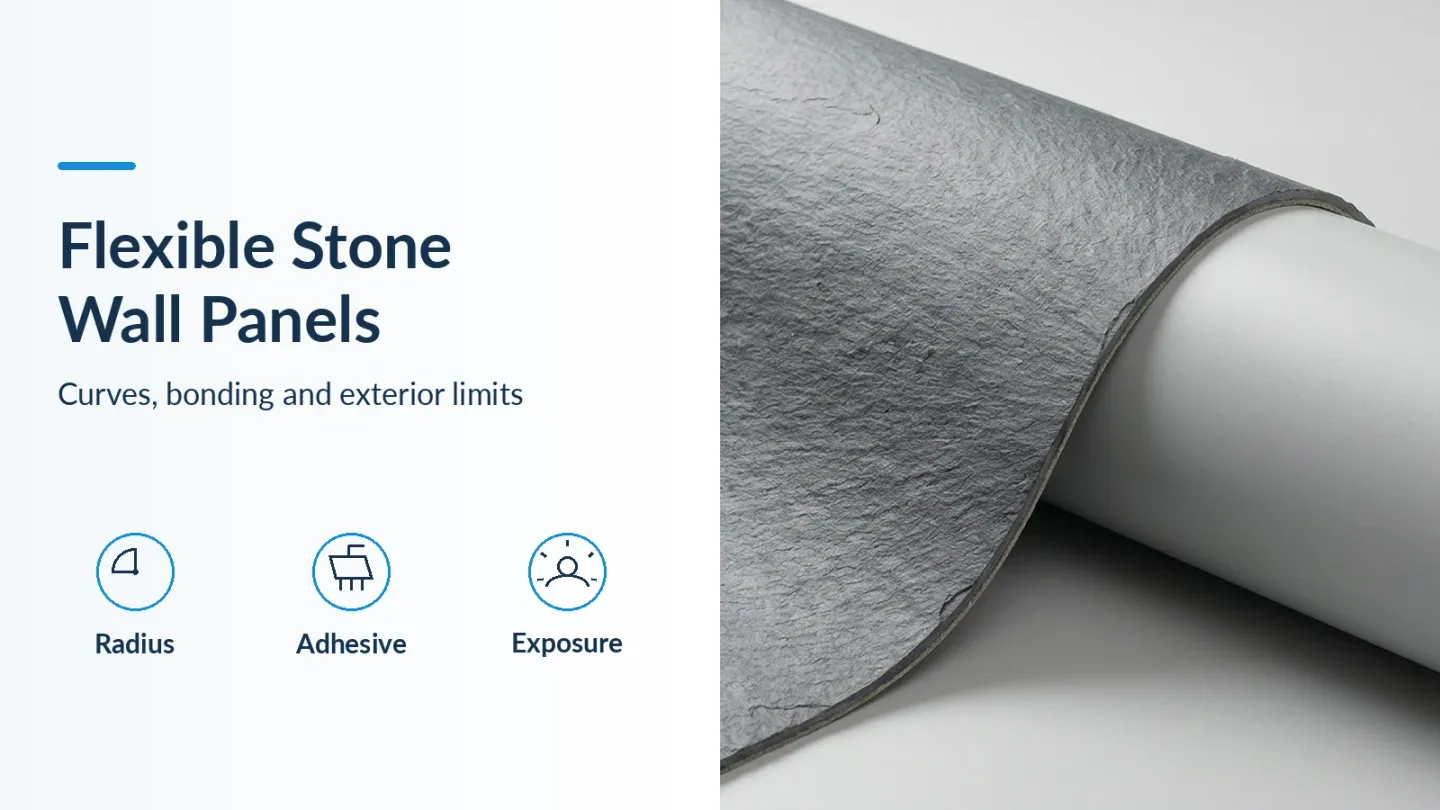
Specifying flexible stone wall panels by appearance alone risks adhesive failure at a curved edge or rework on an exterior wall. Choose flexible stone panels by their construction, documented curve limits and compatible adhesive/substrate combination, with exterior suitability checked separately.
Flexible stone wall panels are thin decorative facings whose construction must be identified before their flexibility or exterior claims can be compared. A natural-stone sheet on reinforced backing and a mineral-composite panel may look similar while needing different adhesives and corner details. Start with the exact product, then check the smallest project radius, substrate condition, bonding instructions and exposure. For exterior stone veneer panels, also establish how the complete wall handles water, drying, movement and fire requirements. The product-specific examples below help organize those checks; they do not create one installation specification for every flexible stone material.
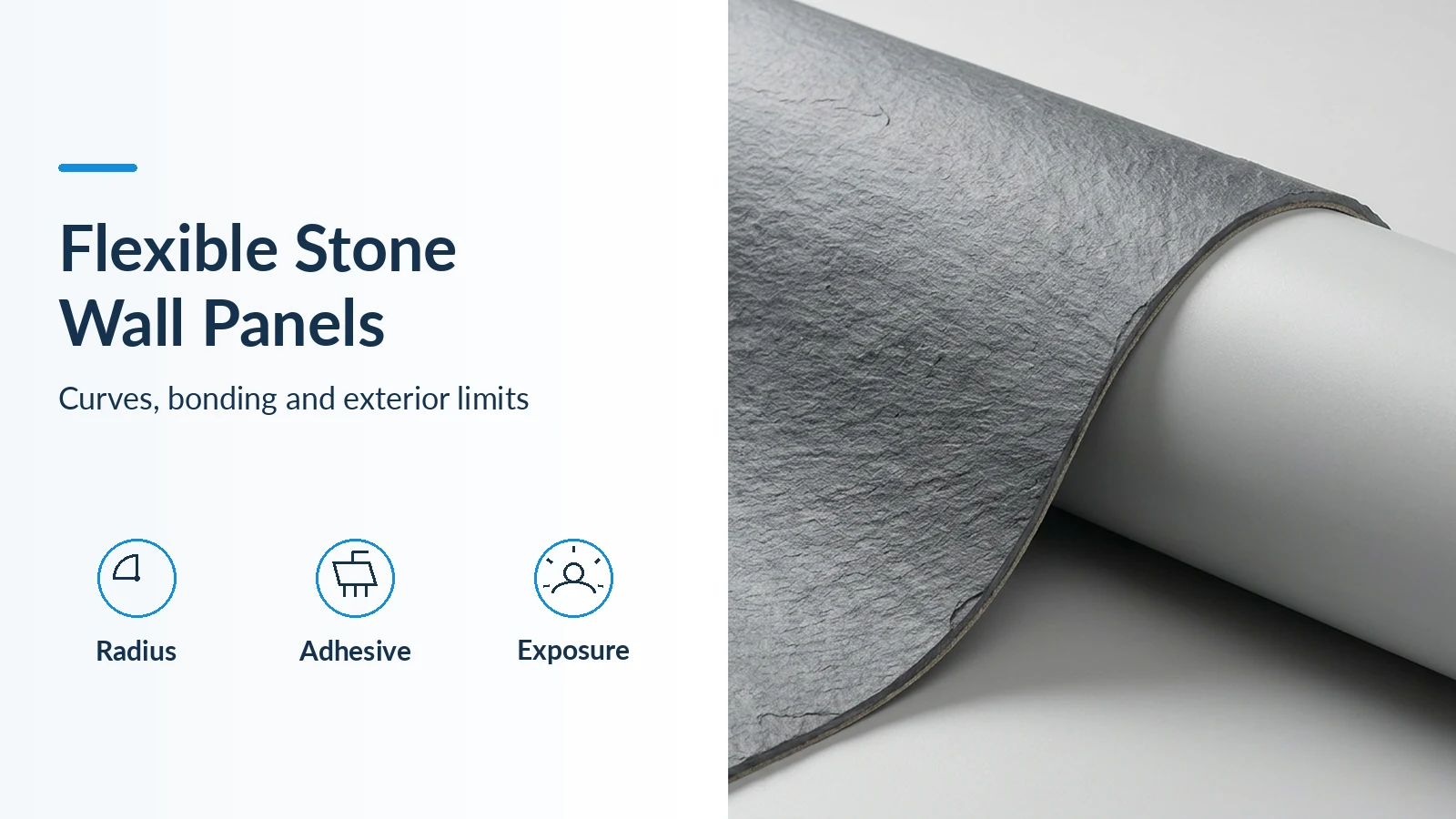
Quick specs: which inputs need product evidence?
Use a named product’s current documents for each input. The numerical examples below belong to Slate-Lite, not to all flexible stone or modified mineral/clay composites.
Scroll horizontally to view all columns.
| Input or item | Typical value or source | Why it matters |
|---|---|---|
| Construction | Slate-Lite’s US data sheet describes stone on glass-fiber-reinforced polyester | The backing participates in bending and bonding |
| Bendable radius | Approximately 5 cm / 2 in for the cited Slate-Lite sheet; data-sheet page 5 | A product planning value to confirm for the selected decor and bend direction |
| Processing temperature | Recommended 10–35 °C / 50–95 °F for that product; data-sheet page 6 | An installation condition, not an exterior service-temperature range |
| Adhesive | Named product and its substrate/exposure instructions | “Flexible” does not identify compatible adhesive chemistry |
| Existing exterior substrate | Dry, clean, frost-free and sound in the Slate-Lite facade guidance | Bond reliability depends on the surface retained behind the finish |
Do not turn a peel-force value for a self-adhesive film into a wall pull-off acceptance criterion. Those measurements describe different loading conditions; the project needs a test method and acceptance basis that match the proposed bond.
Are all flexible stone panels made the same way?
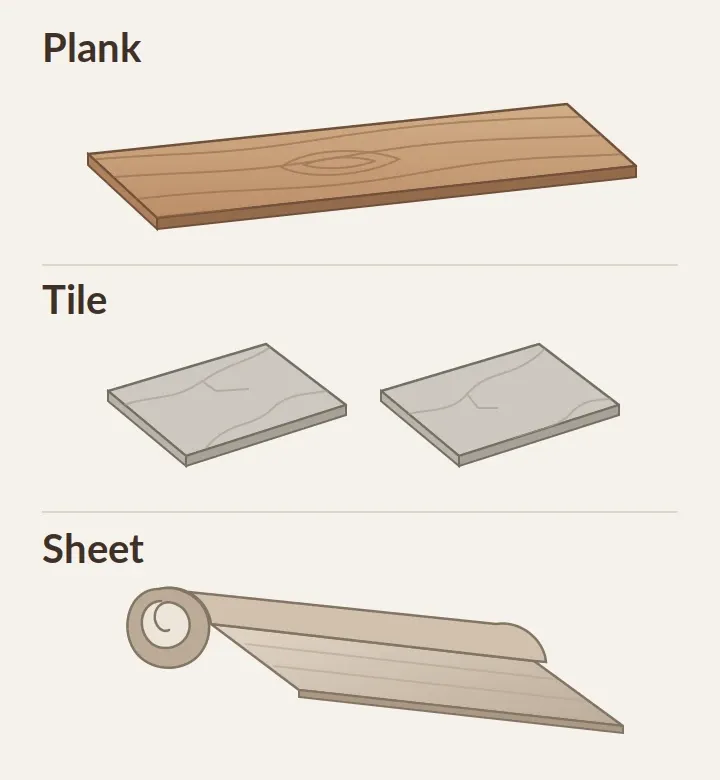
No: identify whether the visible surface is a natural-stone layer or a manufactured mineral texture. Slate-Lite documents the former construction. PHOMI describes eCovering as an econiclay-based flexible veneer that replicates material textures. That description does not establish the same backing, bend radius or bonding requirements.
The flexible stone veneer guide gives background on stone-faced sheets. When comparing a mineral-composite proposal with that material, request an exposed-edge sample and a construction description before carrying specifications across. For the broader weight and material-choice decision, see flexible stone versus natural stone.
Scroll horizontally to view all columns.
| Candidate | Evidence to establish before selection | Dominant Failure Mode & Prevention |
|---|---|---|
| Natural-stone sheet on reinforced backing | Exact backing, curve guidance and compatible bonding system | Forced bending can damage the facing or backing; mock up the tightest curve with the specified product |
| Manufactured mineral-composite panel | Its own composition, installation sheet and exposure evidence | Substituting another flexible product’s adhesive or radius leaves compatibility unverified; qualify the actual panel system |
| Self-adhesive stone-sheet variant | Permitted room conditions and substrate preparation | Using an interior film outdoors or in wet exposure exceeds its stated scope; select a documented system for that exposure |
| Rigid thin stone alternative | Its own support, joint and corner details | Treating a rigid unit as a bendable sheet can break the facing; use a designed jointed or shaped detail |
The last option is a different construction route, covered in the thin stone veneer guide. Compare complete details rather than expecting a flexible sheet and a rigid unit to share an installation method.
How tight a curve can the panel follow?
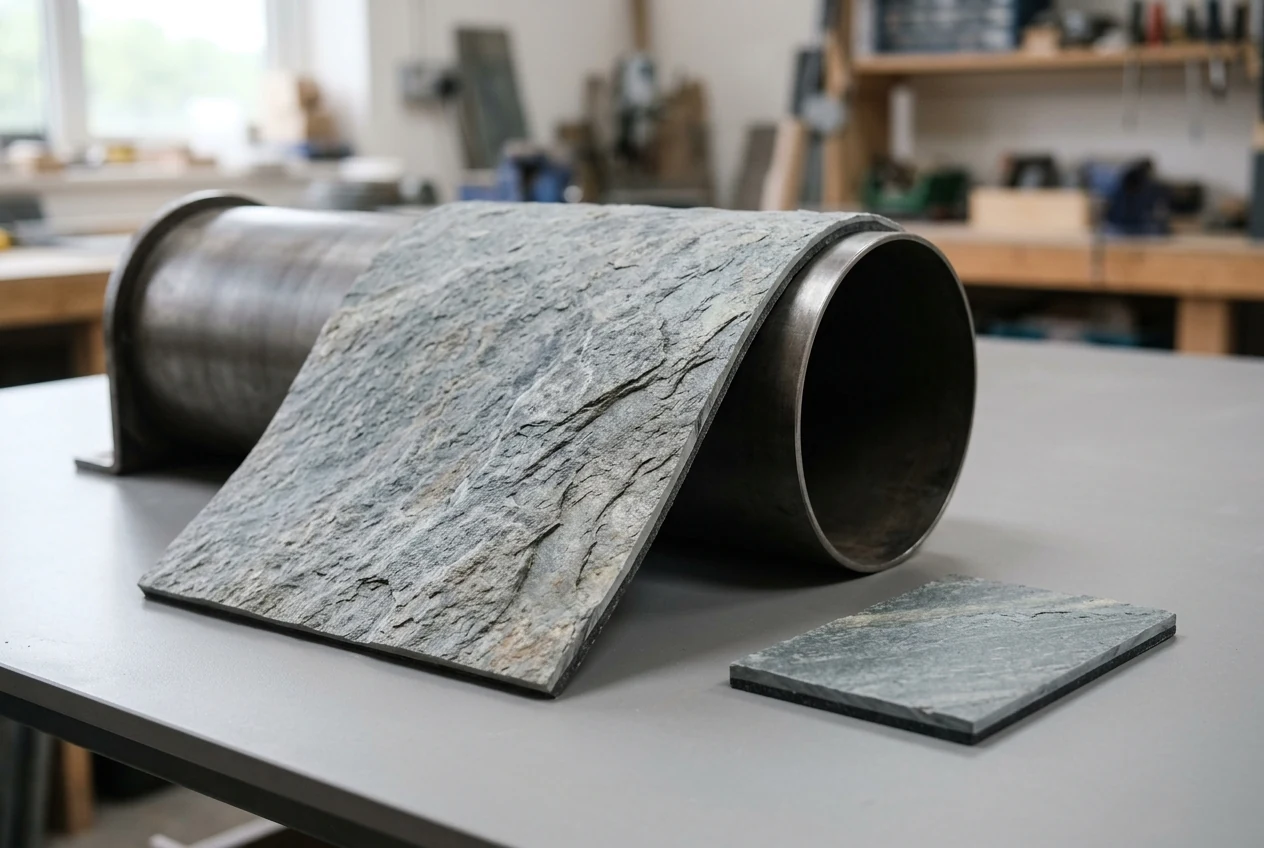
Use the selected product’s documented radius and verify the tightest bend in a mockup. Radius is measured from the center of a curve; a diameter measurement must be converted before comparison. Also record whether the drawing refers to the substrate or the finished surface.
Rules-of-Thumb
If project radius < approximately 5 cm under the cited Slate-Lite bend guidance → choose a jointed corner detail or a product with separately documented tighter-curve capability, because the proposed curve is tighter than that sheet’s published approximate radius. This is a conservative screening rule, not a certified minimum for every decor or bend direction.
A broad circular column and a sharp external corner are different details. Do not use a successful broad-curve sample as evidence for folding a sheet sharply around an edge. Resolve the actual seam, profile or cut-piece arrangement on the drawing.
For a circular reference surface, the developed width follows plane geometry:
s = R × θ × π ÷ 180
Here s is arc length, R is radius in the same length unit, and θ is the covered angle in degrees.
Worked example — assumed geometry: at R = 150 mm and θ = 90°, s = 150 mm × 90 × π ÷ 180 = 235.6 mm of developed arc width.
This hypothetical geometry supplies a setting-out dimension, not proof that a sheet will bend or remain bonded. The final cut width must account for the actual setting-out surface, joint and trim details. A compound curve also requires a separate mockup; the circular-arc formula does not show that a flat sheet can stretch into it.
Which adhesive and substrate checks prevent peeling?
Match the adhesive to the backing, substrate and exposure, then verify the surface that will actually carry the bond. Slate-Lite Extreme Adhesive is described for named Slate-Lite and UltraThin eco+ lines, including interior, exterior and wet-area uses. That product description is not permission to substitute generic mortar or to bond over an unassessed coating.
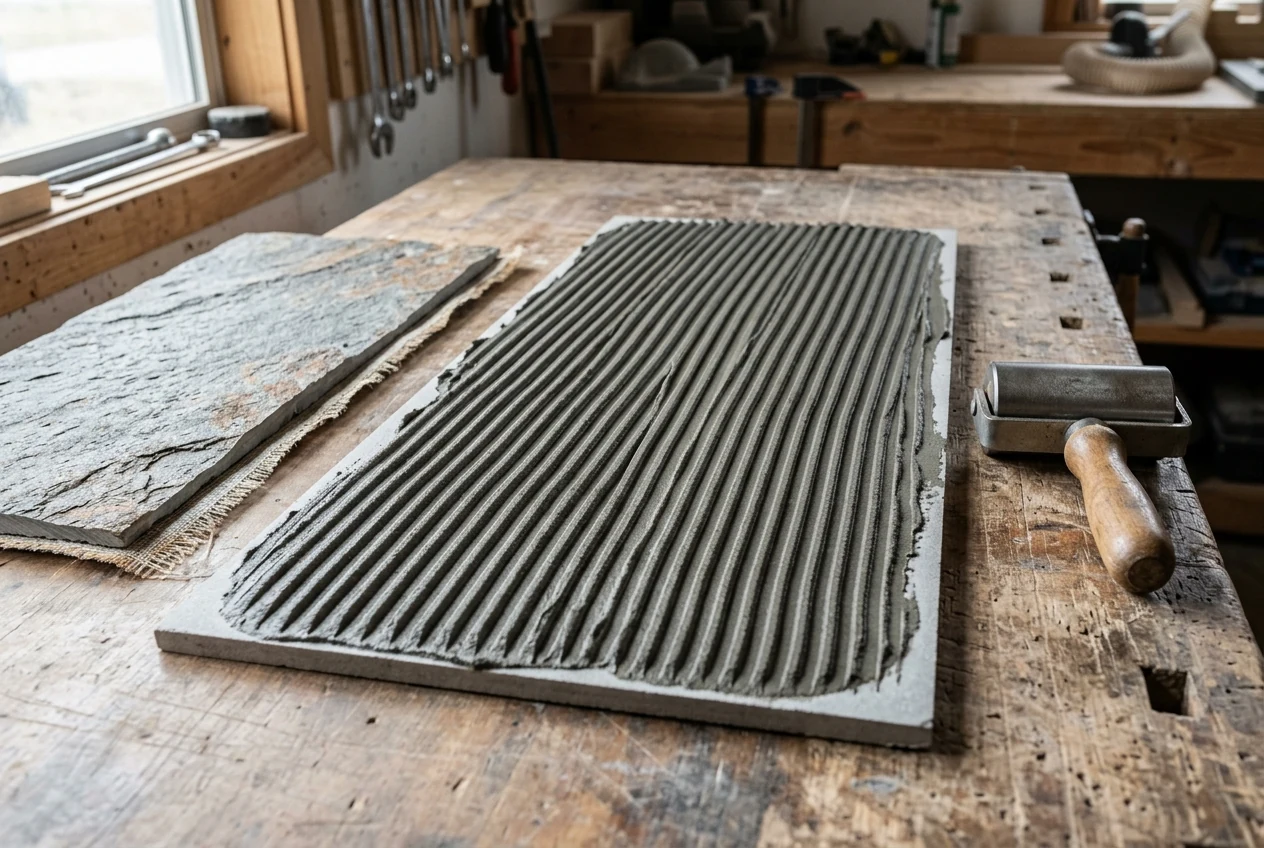
Slate-Lite’s processing instructions specify full-surface adhesive application with a B3 notched trowel and even pressure. Its self-adhesive film is restricted to indoor use outside wet areas. These are separate installation options, not interchangeable adhesive formats.
For an existing wall, establish the bond path from panel backing through adhesive and any retained coating to the sound substrate. Record:
- Which existing layers remain, and whether they are securely bonded.
- How contamination, weak coatings and damaged areas will be removed or repaired.
- Which primer, adhesive and finishing products belong to the proposed system.
- How a representative bond mockup will be evaluated under the selected manufacturer’s procedure.
Agree the acceptance method before installing the field. Do not invent a universal pull-off strength or cure interval to fill a missing product instruction.
Can flexible stone wall panels be used outdoors?
Some products and variants can, but an exterior claim needs a documented wall build-up for the project. Confirm the exact decor and finish as well as the adhesive. Slate-Lite’s data sheet excludes specified limestone decors from wet and outdoor use, illustrating why a family-level exterior statement needs variant checks.
Its separate facade brochure describes an ETICS application and refers to German building classes. It also states that the finish is not vapor-permeable. Those points make the document useful for identifying system questions; they do not establish approval for a US wall.
For a US specification, resolve the proposed substrate, water-management layers, drying path, joints, penetrations and terminations with the wall designer. Obtain the applicable fire and attachment evidence for that build-up and confirm the locally adopted code route. Do not assume that instructions for rigid adhered masonry automatically cover a flexible composite sheet.
Use the exterior wall application guide to frame those assembly decisions. If the proposal cannot identify what happens at an opening or where water drains, a flexible face sample has not completed the exterior specification.
What changes the lifecycle burden?
Include removal and substrate repair when comparing flexible stone with another finish. Adhesive failure can turn a small visible defect into a larger repair if the retained surface must be stripped before rebonding. Record how replacement sheets will meet existing seams and whether a matching finish can be retained for repairs.
The TCO scope should also identify the selected surface-protection system, its cleaning requirements and any recoating or resealing instructions. Keep those requirements tied to the actual product; do not assign a category-wide maintenance interval. Review repairs and future access together with the exterior wall build-up, then return to the materials hub if a different facing route better fits the substrate or exposure.
Method and sources
This guide separates manufacturer-documented construction from editorial selection checks. Slate-Lite’s processing and facade documents supply bounded examples; PHOMI’s product description establishes a different material route without transferring specifications between them. The arc calculation uses stated assumptions. No universal bend limit, bond strength or US exterior-system approval is inferred. Updated October 2026.
Sources
- Slate-Lite US processing instructions and data sheet — Slate-Lite North America Accessed October 19, 2026.
- ETICS facades with Slate-Lite — R&D GmbH, Slate-Lite Accessed October 19, 2026.
- Slate-Lite Extreme Adhesive — product description — Slate-Lite North America Accessed October 19, 2026.
- PHOMI eCovering — product construction and textures — PHOMI Accessed October 19, 2026.