Choosing vinyl from a format label alone risks rework when the room’s moisture and maintenance needs remain unchecked. Separate plank, tile and sheet formats from flexible or rigid-core construction, then examine the exact product’s documents.
The three types of vinyl flooring in this guide are formats, not performance grades. A plank or tile can belong to different constructions, and a sheet needs its own product evidence. Use the format to describe what you are looking at; use the construction, applicable specification and installation documents to assess it. “Waterproof” needs a defined exposure and scope of protection, rather than an assumption that the whole room is protected.
- Format: plank, tile or sheet.
- Construction: record the actual layers and core separately.
- Wear: identify what the thickness figure measures and what the performance evidence covers.
- Water: check the claim, exposure conditions and exclusions for the selected product.
Browse the materials directory for the wider material context; this guide handles vinyl identification rather than retail recommendations.
What are the three vinyl flooring formats?
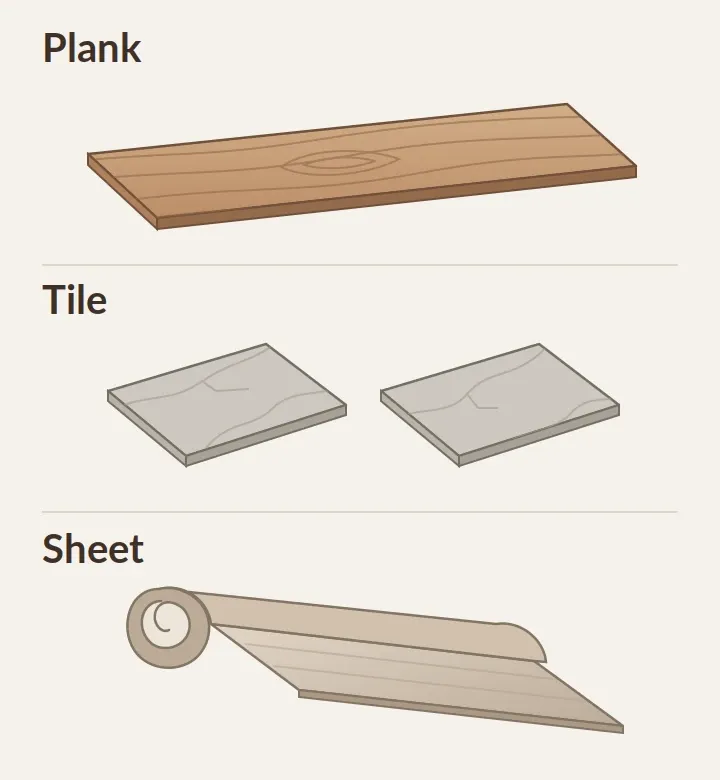
Plank, tile and sheet describe how the floor covering is supplied. Planks are elongated pieces, tiles are separate modular pieces, and sheet vinyl is supplied in rolls. These formats help describe layout and product identity, but do not establish a common wear rating, installation method or waterproof outcome.
On a narrow screen, swipe the table sideways to read the final column.
Scroll horizontally to view all columns.
| Format | What the label describes | What to record next |
|---|---|---|
| Plank | An elongated modular piece | Exact construction, joint or bonding system and product reference |
| Tile | A separate modular piece | Exact construction, dimensions and installation system |
| Sheet | Material supplied in roll form | Backing, product specification and the proposed seam and edge details |
RFCI’s type overview places flexible LVT/LVP and rigid-core products in tile and plank formats. The ISO 10582 scope also distinguishes tile, plank and roll supply forms within its defined PVC product scope. A wood or stone visual does not add a performance result to either description.
Write the candidate’s format on its own line, rather than making it do the work of a complete specification. The guide to building-material types provides the broader distinction between material identity and the function it serves.
Takeaway: Use plank, tile and sheet to identify format; obtain the remaining product information separately.
How do flexible and rigid-core vinyl differ?
Flexible vinyl and rigid-core vinyl describe different product constructions. RFCI identifies a rigid polymeric core and decorative surface in its rigid-core category, with an optional attached underlay. Both flexible and rigid-core products can be modular, so “plank” alone does not tell you which build-up is being proposed.
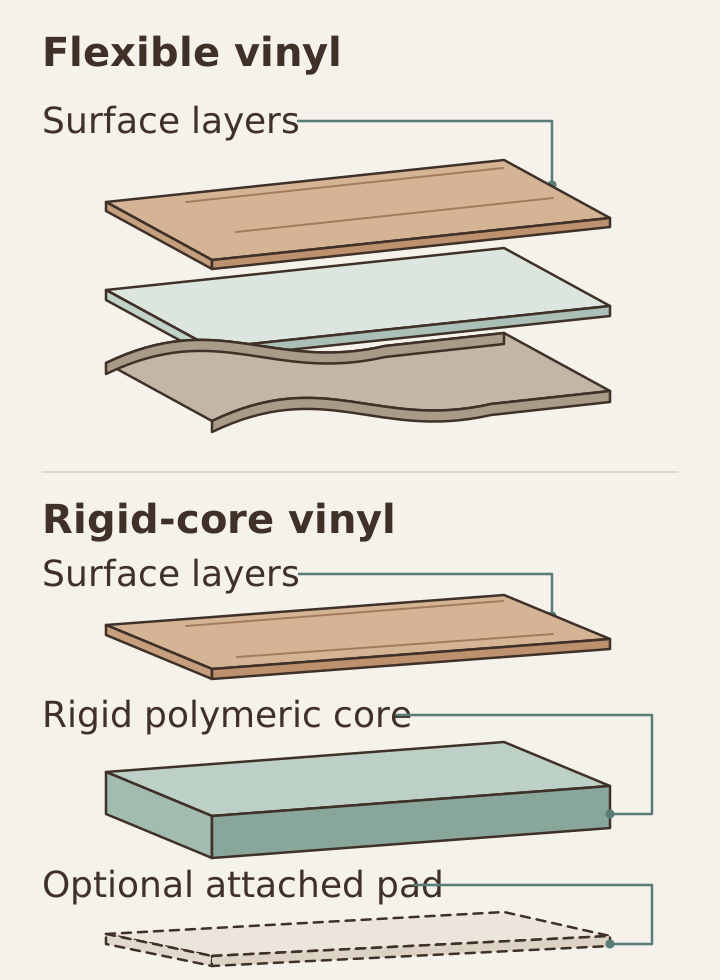
Keep format, construction and installation method in separate fields. A useful description would identify a plank format, a rigid polymeric core and the documented installation system. If a listing only gives “luxury vinyl,” ask for the technical sheet before filling the other fields. Do not infer a glue-down or floating method from a decorative image.
Common mistake: Treating plank, sheet and rigid core as three mutually exclusive alternatives. The first two describe formats; rigid core describes a construction.
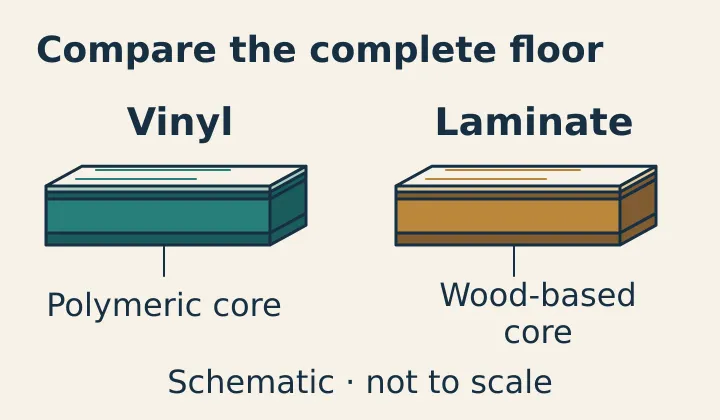
For the different question of vinyl against wood-based flooring, use the vinyl-versus-laminate construction comparison. Do not use a laminate core description to fill a missing vinyl field.
Takeaway: Describe the format, the actual build-up and the installation system independently.
Which flooring standards should you check?
Match a cited specification to the product construction and edition. The official catalogues checked on October 8, 2026 list ASTM F1700-25, F3261-26 and F1303-26 as active; ISO lists 10582:2017 as published and confirmed. Those catalogue records establish scope and status, rather than compliance by an unnamed floor covering.
On a narrow screen, swipe sideways to read the limits in the final column.
Scroll horizontally to view all columns.
| Official record checked | Public scope relevant here | What the record does not establish |
|---|---|---|
| ASTM F1700-25 | Modular solid vinyl flooring in tile or plank format | Compliance by every product sold as LVT or LVP |
| ASTM F3261-26 | Modular resilient flooring with a rigid polymeric core | That a rigid-core sales label proves the required performance |
| ASTM F1303-26 | Sheet vinyl floor covering with backing | A universal requirement for every roll-form resilient material |
| ISO 10582:2017 | Non-cushioned heterogeneous PVC floor covering in tile, plank or roll form | Coverage of all vinyl constructions or certification of a particular product |
The suffix matters when a product document refers to a particular edition. Record it as printed, then check whether the document supports the claim needed for the project. An older test report and a current catalogue entry are different records; do not silently rewrite the report’s edition.
This table uses public abstracts and scopes. It does not reproduce the full standards or their acceptance tables. Follow the site’s fact-checking method when distinguishing a published specification from evidence about a specific product.
Takeaway: A relevant standard and current catalogue entry are starting points; product-specific compliance needs its own evidence.
What does the wear-layer figure actually tell you?
A wear-layer figure describes a particular surface-layer thickness, while total thickness describes the complete product. Keep those measurements in separate fields, including units and the supplier’s layer definition. Neither field alone answers every question about wear-through, scratching, indentation or the expected service life of an installed floor.
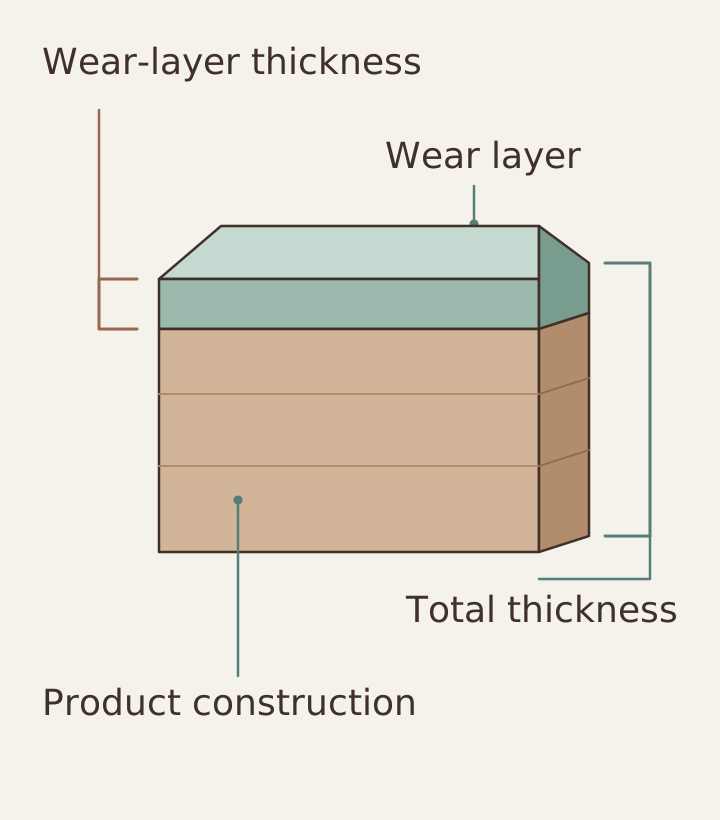
The public F1303 abstract distinguishes product types, grades and backing classes for its sheet-vinyl scope. That is a reason to ask which classification a requirement belongs to, rather than transferring a number from one product construction to another. The full acceptance requirements were not available for this guide, so it gives no universal minimum wear-layer thickness.
Before relying on a wear figure, ask:
- What layer is being measured, and does the technical sheet identify it?
- Which product and construction does the figure describe?
- Which specification, edition and classification support the stated requirement?
- Is the accompanying evidence about wear-through, scratches, indentation or another property?
- Does the intended room and use match the scope of that evidence?
A specific US residential warranty example, revised August 2021, distinguishes wear-through from scratches and dents. That wording illustrates why a wear warranty should not be read as protection against every visible surface change; it is not a general rule for all brands.
For a comparison across materials, the vinyl-and-laminate wear discussion explains why unlike evidence should not become a shared score.
Takeaway: Identify the measured layer and the damage mechanism before interpreting a thickness or wear claim.
What can a waterproof claim cover?
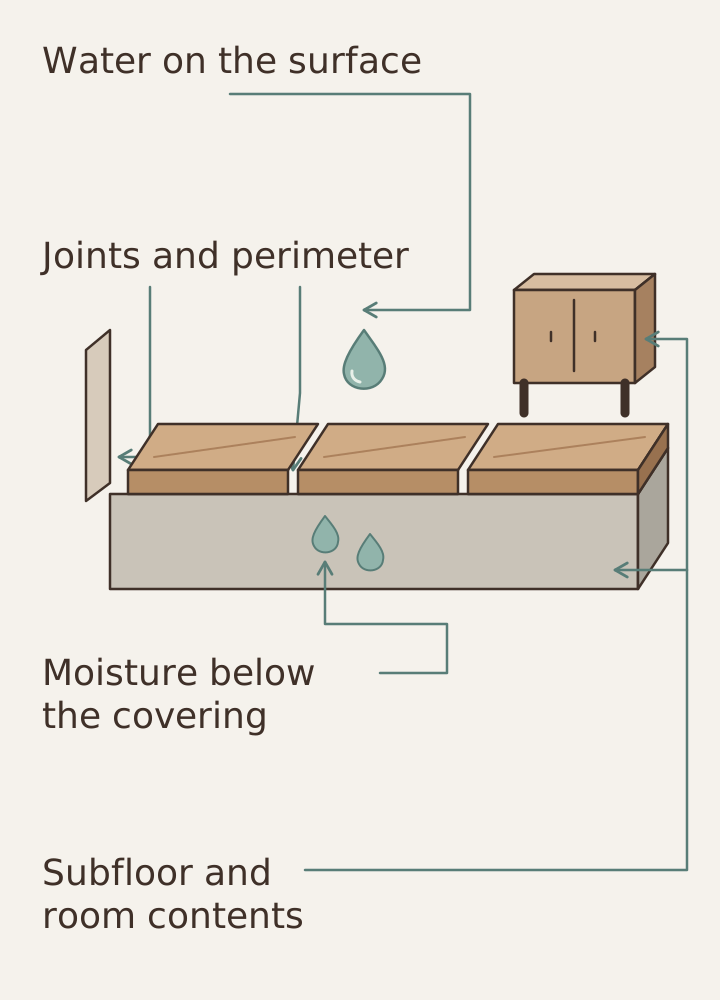
A waterproof claim needs a named product, defined exposure and stated protection. Read whether it concerns the floor covering itself, the joints, surrounding edges or damage below the covering. A product warranty is evidence of a contractual promise and exclusions; it is not a laboratory result for the whole room.
In the August 2021 COREtec Galaxy residential warranty example, topical-moisture coverage is limited where water passes over the surface edge, including room edges and cut boards. The document also excludes floods and problems arising from excessive subfloor moisture or water pressure. It does not establish protection for the surrounding structure or room contents. Use this as a concrete example of claim boundaries, then obtain the applicable warranty for the product being considered.
Scroll horizontally to view all columns.
| Exposure or protected item | Question for the product record |
|---|---|
| Water on the surface | Which spills or cleaning exposures are addressed, and under what conditions? |
| Joints and perimeter | Does the claim include them, and is a prescribed detail needed? |
| Moisture below the covering | Which substrate conditions and preparation instructions apply? |
| Subfloor and room contents | Are these included in the promise or expressly excluded? |
| Flooding or persistent standing water | Is the exposure addressed at all? |
Common mistake: Turning a statement about a floor covering into a claim that it waterproofs the room.
No water-test result for a candidate product was reviewed here, so this guide makes no tested water-resistance finding for plank, tile or sheet as a category. To assess a performance claim, obtain the exact report, test conditions and measured result. The vinyl-and-laminate water comparison keeps material selection separate from room-level protection.
Takeaway: Record the exposure, protected item and exclusions before relying on “waterproof.”
Which limitations matter before ordering?
Connect the product record to the actual room before choosing a format. A missing substrate assessment, unsuitable care routine or unresolved exposure is a question to close before ordering. Plank, tile and sheet labels cannot answer those questions, and a rigid core does not establish that preparation can be skipped.
A published SPC installation example separately addresses installation methods and subfloor conditions. It illustrates the need for the matching instructions; it does not supply a universal preparation recipe for vinyl flooring.
On a narrow screen, swipe sideways to read the next action in the final column.
Scroll horizontally to view all columns.
| Record | Why it matters | Next action |
|---|---|---|
| Room and use | Identifies the actual exposure and use to be assessed | Describe routine use and foreseeable moisture |
| Substrate identity and condition | Connects the covering to the surface supporting it | Have the existing floor assessed before prescribing preparation |
| Installation system | Identifies the relevant joint, adhesive and accessory instructions | Obtain the instructions for the exact product |
| Water and wear evidence | Separates the claimed properties and their conditions | Keep reports and warranty definitions beside the technical sheet |
| Care requirements | Shows whether the proposed cleaning routine is allowed | Compare the maintenance leaflet with the planned routine |
| Document identity | Keeps a different range or market from being substituted | Record product reference, region, edition and revision |
The broader material-selection sequence begins with constraints before appearance. Apply that sequence to the floor itself, rather than transferring wall or facade specifications to flooring. For the next comparison, see how subfloor preparation changes the vinyl-and-laminate decision.
Takeaway: Close the room, substrate, installation and care questions before treating a candidate as suitable.
When this does not apply
This format guide does not design a shower floor, remediate a wet substrate or establish suitability after flooding. It also does not confirm a commercial specification or regulatory requirement. In those cases, use the relevant project requirements and exact product evidence, with a qualified assessment of the proposed floor system.
Pause selection if the proposed use depends on protection that the available documents do not address. For example, a room-level water-containment requirement needs more than the word “waterproof” on a carton. A moisture problem beneath an existing floor needs diagnosis rather than a different decorative format.
Where the planned cleaning process or heating system creates an additional condition, resolve it with the matching care or installation instructions. The flooring comparison’s maintenance section provides a related check without replacing those documents.
Takeaway: Use this guide to identify questions; obtain a project-specific assessment where the required performance goes beyond the available evidence.
Build a product record before choosing
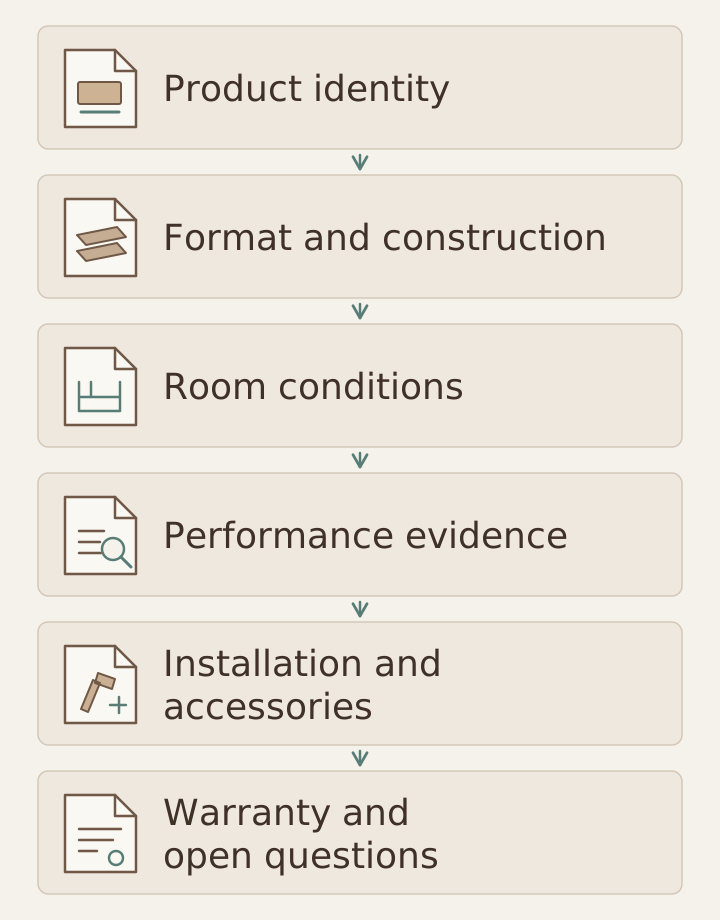
Make a short record for each candidate that separates appearance, construction and evidence. The result should let another person identify the exact floor covering and see which questions remain open. A blank field should stay unresolved until its source is available, rather than being filled from a similar-looking product.
Scroll horizontally to view all columns.
| Field to keep | Suitable record |
|---|---|
| Product identity | Exact product reference and market |
| Format and construction | Separate descriptions, supported by the technical sheet |
| Room conditions | Use, moisture history, substrate and proposed care |
| Performance evidence | Applicable specification plus the relevant product reports |
| Installation and accessories | Matching instructions and identified system components |
| Warranty and open questions | Applicable contract, exclusions and the person who can clarify them |
Use the record to discuss remaining questions with the product supplier and installer. Once the vinyl candidate is identified, the vinyl-versus-laminate guide addresses the separate choice between those material systems. Return to constraint-led material selection if the room requirements themselves are still unclear.
Related reading:
- Types of building materials — keep material categories separate from their application.
- Vinyl versus laminate flooring — compare water, wear, substrate and care evidence across the two systems.
Takeaway: Choose from an identifiable product record with resolved requirements, rather than a format label alone.
Frequently asked questions
These questions address abbreviations and adjacent accessory or care decisions. The accessory examples come from UK product guidance and should not be treated as instructions for every US-market vinyl floor.
Which is better, vinyl or LVP?
LVP means luxury vinyl plank, so it is a description within vinyl flooring rather than a separate material competing against it. Clarify whether the proposed plank is flexible or rigid-core, then assess its documents. A broader “vinyl” listing without that information is not yet a comparable candidate.
What is the downside of LVT flooring?
LVT means luxury vinyl tile; RFCI also uses it for products supplied as planks. One practical limitation is that a wear-through warranty can still exclude visible scratches and dents, as the US warranty example above does. If those forms of damage matter to you, obtain evidence for them separately rather than treating the wear promise as a surface-damage guarantee.
Can I use a laminate underlay for my vinyl floor?
Do not substitute it from appearance alone. Quick-Step’s UK answer rejects that substitution for its system, referring to thickness and compressive strength. For a US purchase, use the exact floor’s approved accessory instructions and confirm compatibility with its supplier.
Do I always need a vinyl underlay?
There is no answer from format alone. Quick-Step’s UK guidance includes a product with an attached pad for which additional underlay is not permitted. Check whether the selected product requires, allows or prohibits a separate layer; an attached pad is not permission to add another.
Can you use a steam mop on vinyl flooring?
Check the exact maintenance leaflet. A manufacturer’s published UK answer permits steam cleaning for a named range only under conditions. That does not authorize it for all vinyl floors. If steam cleaning is essential to the intended routine, resolve that requirement before selection.
Can I combine vinyl flooring and underfloor heating or cooling?
Compatibility depends on the selected floor and system instructions. Published UK product guidance sets conditions for heat and cooling rather than giving unrestricted permission. Obtain the US-market product’s limits and have the heating or cooling installer check the proposed assembly against them.
Takeaway: A product-specific accessory or care answer should not become a rule for the entire vinyl category.
Sources and method
This guide compiles public official standards records, RFCI’s material descriptions and manufacturer-document examples. Catalogue scope and status were checked on October 8, 2026. The full paid standards and candidate-product test reports were not reviewed; the guide therefore does not publish compliance thresholds, water-test outcomes or service-life estimates.
The US warranty example is identified by its August 2021 revision to illustrate a boundary, not to describe every current contract. UK accessory and care examples demonstrate why matching product instructions matter; their conditions are not transferred to the US market. Conceptual drawings identify fields and exposure locations, not measured layer proportions or tested assemblies.
The source list below provides the original records and access dates. Follow the editorial evidence policy when distinguishing this public-source explanation from a product evaluation.
Takeaway: Use the original records to resolve a candidate’s evidence; this page explains what to check and what those records cannot prove by themselves.
Sources
- ASTM F1700-25 public scope and active status Accessed October 8, 2026.
- ASTM F3261-26 public scope and active status Accessed October 8, 2026.
- ASTM F1303-26 public scope and active status Accessed October 8, 2026.
- ISO 10582:2017 official scope and status Accessed October 8, 2026.
- RFCI resilient flooring types Accessed October 8, 2026.
- COREtec Galaxy residential warranty example, revised August 2021 Accessed October 8, 2026.
- Shaw SPC installation document example Accessed October 8, 2026.
- Quick-Step UK, laminate underlay with vinyl Accessed October 8, 2026.
- Quick-Step UK, when vinyl underlay is required Accessed October 8, 2026.
- Quick-Step UK, steam-cleaning conditions Accessed October 8, 2026.
- Quick-Step UK, underfloor heating and cooling conditions Accessed October 8, 2026.