Select decorative wood panels for walls by matching the underlying core architecture, mounting hardware, moisture acclimation window, surface-burning classification, and composite wood emission label to the room before ordering. When evaluating wooden wall panels for living room feature walls or commercial corridors, compare the substrate anatomy alongside the broader building materials catalog and our framework on how to choose building materials.
Compare decorative wood wall panel core architectures
Takeaway: Match the panel core and mounting profile to the wall flatness, acoustic target, and room humidity regime before selecting a face veneer.
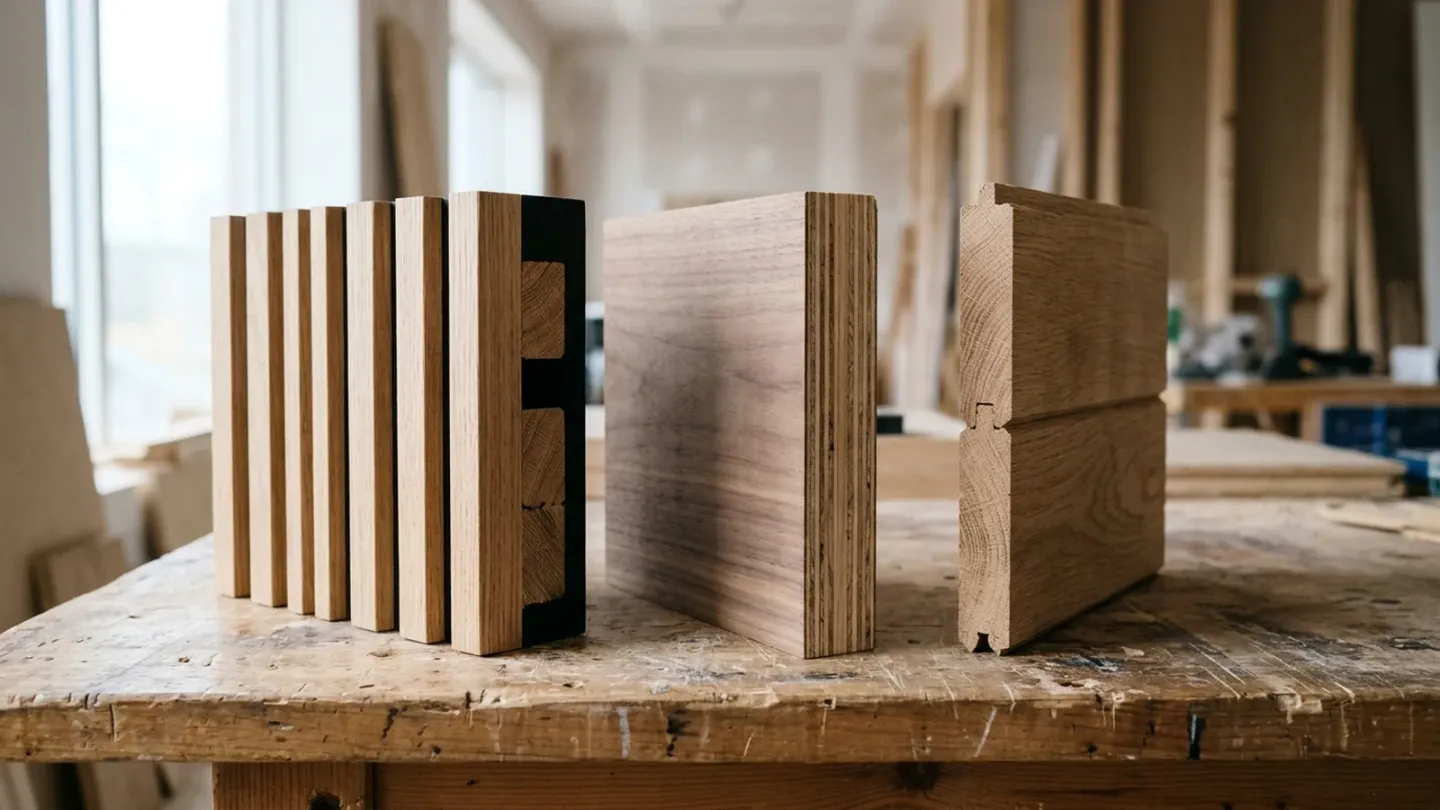
Architectural wood wall coverings fall into three distinct structural families within the broader category of interior wall panels: flat decorative hardwood plywood built on veneer inner plies with or without engineered fiberboard crossbands, factory-veneered fire-rated particleboard panels and slatted grilles, and solid lumber tongue-and-groove boards. The table below compares published specifications across four representative engineered panel systems.
Scroll horizontally to view all columns.
| Panel System | Core and Surface Construction | Published Sizes and Profiles | Weight, Density, and Fire or Acoustic Baseline |
|---|---|---|---|
| Columbia Forest Products Classic Core | Classic Core offers a construction of veneer core inner plies and MDF cross bands, and while Classic Core falls within the HPVA thickness tolerance of +0 / -3/64”, its engineered MDF cross bands provide more consistent thickness tolerances compared with single-step, veneer core construction. | Classic Core panels can be specified as PureBond and constructed with no added formaldehyde pMDI MDF cross bands, and standard thicknesses for Classic Core include 1/2”, 5/8”, 3/4”, 1” and 1-1/4”. | In Columbia Forest Products’ 3/4” thickness test table for 48.5 X 96.5” panels, Classic Core is listed at 38.4 lbs/ft³ and Softwood Veneer Core at 27.3 lbs/ft³. Multiplying those densities by the stated panel volume (~2.03 ft³) gives about 78 lb and 55 lb per panel respectively—use the density row or re-weigh a sample rather than treating 74 lb / 54 lb as exact with those dimensions. |
| Armstrong WoodWorks Wall Panels | Armstrong WoodWorks Wall Panels are constructed of Fire-Rated Particle Board (FRPB) with real wood veneers (or FRPB with a reconstituted veneer for NVF, CWA, and CRW) and weigh 2.75 LBS/SF. | Armstrong WoodWorks Wall Panels include nominal 24 x 48 x 3/4”, 24 x 96 x 3/4”, 24 x 108 x 3/4”, and 24 x 120 x 3/4” sizes, with Edge Square (E1) for Z-clip installation and Edge Kerfed (E4) for Spline installation. | Armstrong WoodWorks Wall Panels achieve Class A ASTM E84 surface burning characteristics with a Flame Spread Index of 25 or less and a Smoke Developed Index of 50 or less. |
| Armstrong WoodWorks Grille – Forté | Armstrong WoodWorks Grille – Forté veneered panels are made of fire-rated particle board (FRPB) with real wood veneers (or FRPB with a reconstituted veneer for Vertical Grain Fir NVF) and achieve ASTM E84 Class A surface burning characteristics with a Flame Spread Index of 25 or less and a Smoke Developed Index of 50 or less. | Standard Armstrong WoodWorks Grille – Forté veneered panel configurations are 12” width with 3/4” slat width in 4’, 6’, and 8’ nominal lengths, with 3, 4, 5, or 6 slats per panel (81%, 75%, 69%, and 63% open area) and slat heights of 2-1/2”, 3”, 3-1/2”, and 4”. | Armstrong WoodWorks Grille – Forté panels can be installed in the ceiling, on the wall, or to create ceiling-to-wall transitions, and black acoustical infill panels provide NRC up to .85 and CAC up to 35. |
| Armstrong WoodWorks Linear Veneered Open | Armstrong WoodWorks Linear Veneered Open planks are made of fire-rated particle board (FRPB) with real wood veneers (or FRPB with a reconstituted veneer for Vertical Grain Fir NVF) and factory-applied black fleece on each plank to cover the reveal, offered as a 4-1/2” O.C. plank (3-3/4 x 96 x 3/4” with 3/4” reveal) and a 6” O.C. plank (5-1/4 x 96 x 3/4” with 3/4” reveal) weighing 2.75 LBS/SF. | Armstrong WoodWorks Linear Veneered Open planks must be climatized prior to installation with relative humidity between 25% and 55% and temperatures between 50˚F and 86˚F maintained, and for expansion a 3/4” gap is recommended at every 24-foot run of plank. | Armstrong WoodWorks Linear Veneered Open planks must be climatized prior to installation, and relative humidity between 25% and 55% and temperatures between 50˚F and 86˚F must be maintained. |
Flat hardwood plywood cores: telegraphing, density, and fastener withdrawal
Takeaway: Specify combination-core hardwood plywood with fiberboard crossbands when thin decorative veneers require uniform thickness and resistance to core telegraphing.
When evaluating wall panel ideas for living room millwork, architectural feature walls, or custom bookmatched wainscoting, the crossband directly beneath the face veneer determines whether core defects show through under grazing light. Just as multi-layer stability separates engineered boards in our laminate vs hardwood flooring comparison, combining veneer-core inner plies with smooth fiberboard crossbands changes surface uniformity, panel weight, and fastener withdrawal capacity.
Classic Core provides a smooth, sound surface with higher density than traditional veneer core, reducing the potential for core telegraphing through decorative veneer overlays and finishing problems from open knot holes or open joints in veneer core cross band constructions allowed under the HP-1 voluntary decorative hardwood plywood standard. For end users needing a core closer to a full 3/4”, Columbia Forest Products offers a 19.5mm (.767) J Classic Core, with a construction upgrade replacing NAUF MDF crossbands with pMDI bonded MDF cross bands for no added formaldehyde construction.
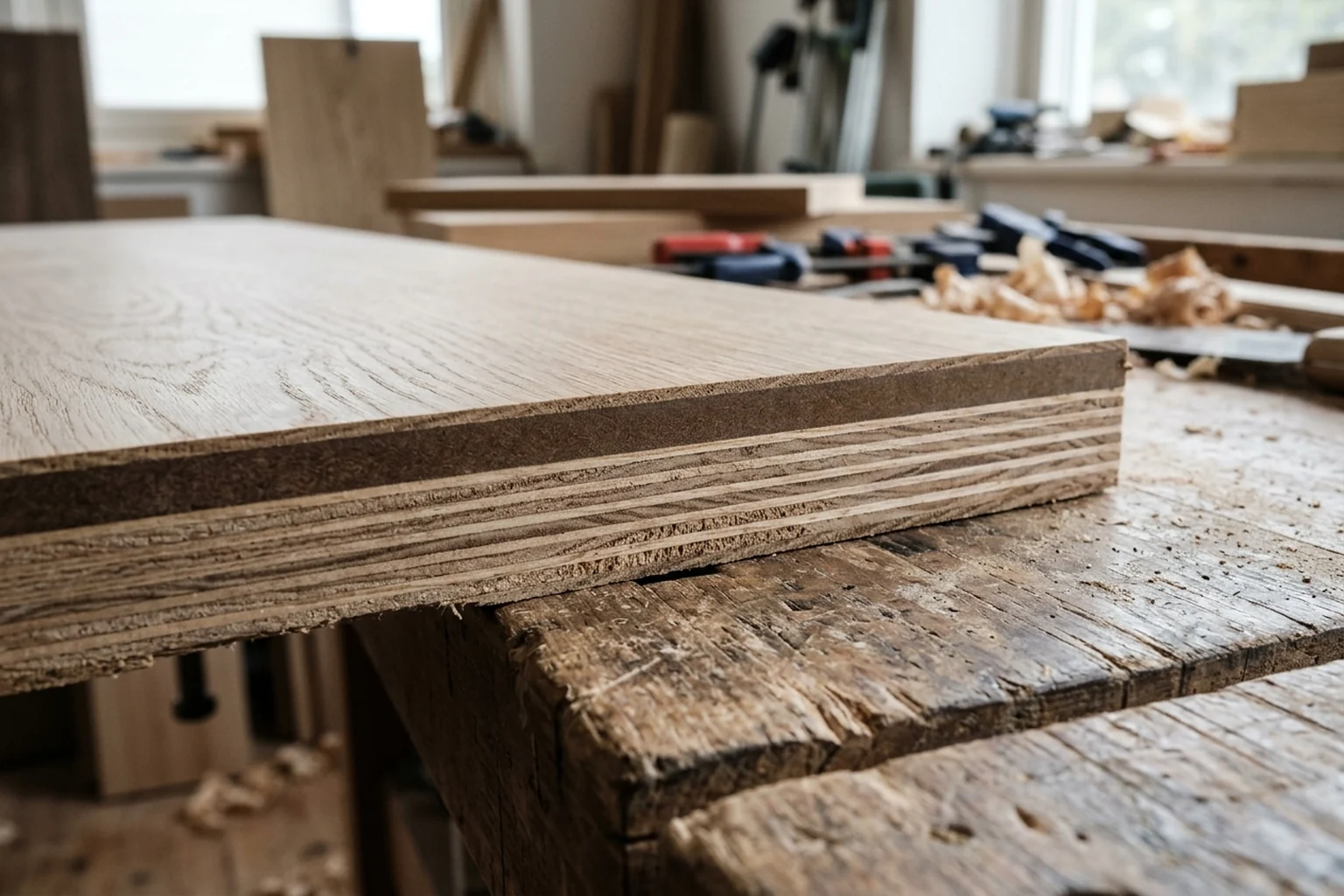
Bending stiffness, modulus of rupture, and mechanical screw holding capacity also separate combination-core panels from softwood veneer cores:
- In Columbia Forest Products’ 3/4” thickness panel test table, Classic Core has a modulus of rupture (MOR) of 6,010 psi and modulus of elasticity (MOE) of 670,894 psi, compared with 5,171 psi MOR and 663,111 psi MOE for Softwood Veneer Core.
- In Columbia Forest Products’ 3/4” thickness test table, Classic Core has a face screw withdrawal of 274 lbs, an edge screw withdrawal of 288 lbs, and a Janka Ball Hardness of 866.
Slatted grille and linear veneered fire-rated particleboard systems
Takeaway: Pair Armstrong WoodWorks Grille – Forté veneered panels with notched and diagonal alignment backers and black acoustical infill panels; for Armstrong WoodWorks Linear planks, a 3/4” expansion gap is recommended at every 24-foot run of plank.
Slatted wood grilles and linear reveal planks are used when comparing wooden wall panels for living room media walls, open-plan lobbies, and ceiling-to-wall transitions. Unlike synthetic polymer profiles covered in our guide to wpc wall panels, Armstrong WoodWorks Grille – Forté systems pair real or reconstituted wood veneers over fire-rated particleboard cores with alignment backers and acoustic infills, while Armstrong WoodWorks Linear Veneered Open planks use factory-applied black fleece to cover the reveals.
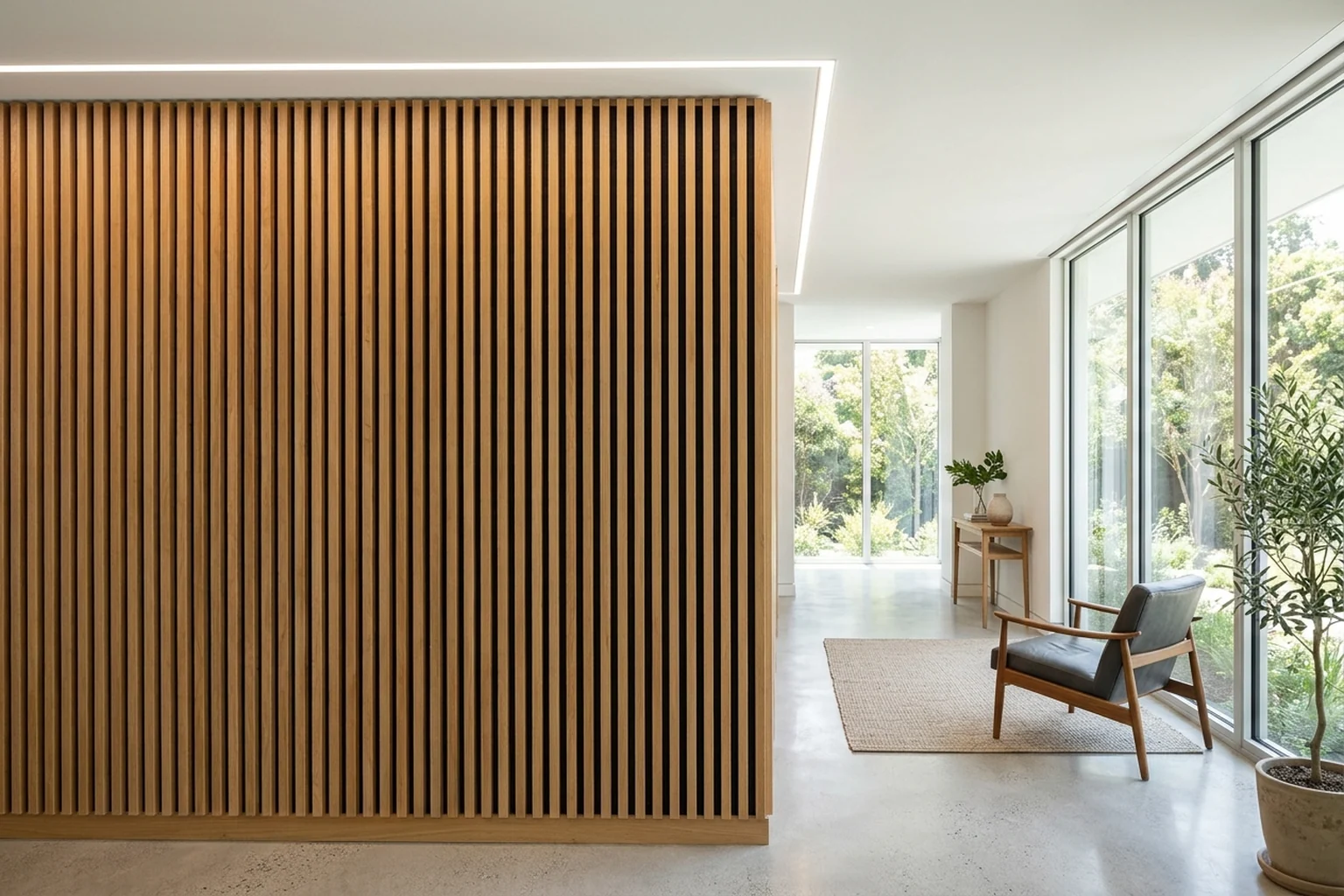
For Armstrong WoodWorks Grille – Forté veneered panels, notched and diagonal backers reinforce slat alignment and minimize the naturally occurring twist of wood:
- Armstrong WoodWorks Grille – Forté veneered panels incorporate notched and diagonal backers (utilizing a 1” notched alignment backer regardless of slat height) to reinforce slat alignment and minimize the naturally occurring twist of wood.
Solid wood hygroscopic movement, anisotropic shrinkage, and acclimation
Takeaway: Acclimatize solid tongue-and-groove lumber in the installation room before fastening. Protective coatings such as varnish, lacquer, or paint can retard, but not prevent, moisture content changes.
Solid lumber boards bring natural grain depth and milled joinery to interior walls, sharing the same hygroscopic cell-wall mechanics that govern exterior wood cladding. Because solid wood lacks cross-laminated inner plies, bound-water changes below the fiber saturation point translate directly into dimensional change across the width of the board.
The moisture content at which only the cell walls are completely saturated (all bound water) but no water exists in cell lumina is called the fiber saturation point (FSP), MCfs. Below MCfs, wood changes dimension as it gains moisture (swells) or loses moisture (shrinks) because the volume of the cell wall depends on the amount of bound water, which can result in warping, checking, and splitting of the wood. With respect to dimensional stability, wood is an anisotropic material that shrinks and swells most in the direction of the annual growth rings (tangentially), about half as much across the rings (radially), and only slightly along the grain (longitudinally). In Figure 4–4 of the USDA Wood Handbook, tangential shrinkage of wood is about twice as great as radial shrinkage. Longitudinal shrinkage of wood (shrinkage parallel to the grain) is generally quite small, with average values from green to ovendry between 0.1% and 0.2% for most species of wood. Reaction wood and juvenile wood can shrink 2% from green to ovendry, and the presence of reaction wood or cross grain in the same board with normal wood can cause serious warping such as bow, crook, or twist. Moisture content changes in wood can be retarded, but not prevented, by protective coatings such as varnish, lacquer, or paint (Chap. 16).
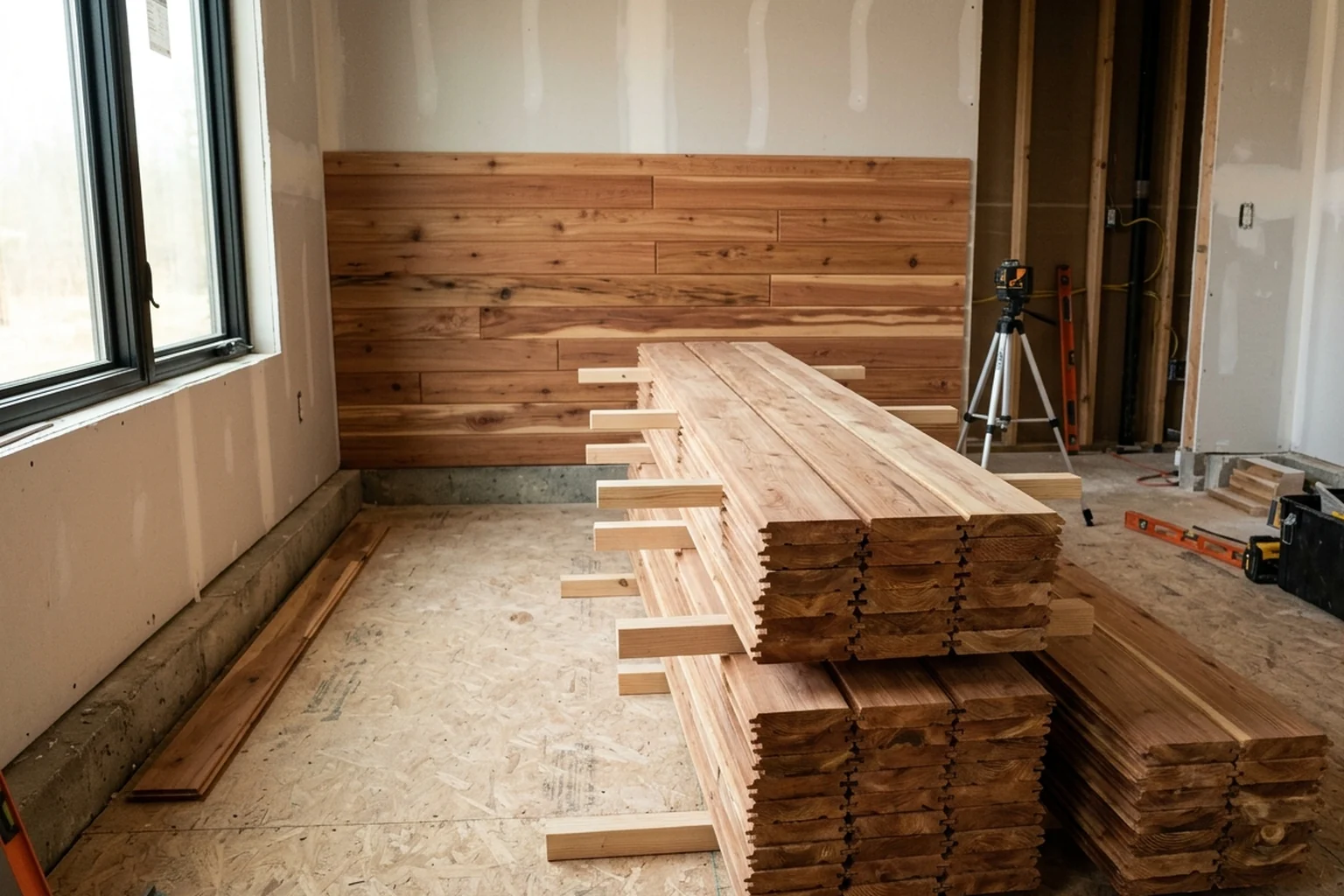
When specifying solid cedar tongue-and-groove boards for interior rooms, match the seasoning grade to the jobsite acclimation schedule and select a joinery profile that accommodates seasonal movement:
- Typically speaking, kiln dried clear cedar will take 3-5 days, dry knotty cedar will take 7-10 days, and green (unseasoned) cedar will take at least 30 days to acclimatize before indoor installation.
- Real Cedar T&G indoor paneling can be selected with a rough face or smooth face and joined using V-shaped, flush, reveal, or radial joinery.
Interior surface-burning classes versus assembly fire resistance
Takeaway: Distinguish tunnel surface-burning flame spread classifications from full-scale wall assembly fire-endurance ratings during submittal review.
Building codes separate the surface flame-spread behavior of an interior decorative wood finish from the hourly fire-containment rating of a complete wall assembly. Specifiers must verify both the interior finish class required for the room or corridor and the test boundary of the cited fire standard.
- Interior wall and ceiling finish materials shall be classified in accordance with ASTM E84 or UL 723 and grouped in classes in accordance with their flame spread and smoke-developed indexes.
- Class A interior wall and ceiling finish materials have a flame spread index of 0-25 and a smoke-developed index of 0-450.
- Class B interior wall and ceiling finish materials have a flame spread index of 26-75 and a smoke-developed index of 0-450.
- Class C interior wall and ceiling finish materials have a flame spread index of 76-200 and a smoke-developed index of 0-450.
Understand the exact scope and mounting conditions of tunnel surface-burning tests versus full-scale assembly fire endurance tests before approving product submittals:
- Test Method E84 is a 10-min fire-test response method that exposes a nominal 24-ft (7.32 m) long by 20-in. (508 mm) wide specimen to a controlled air flow and flaming fire exposure adjusted to spread the flame along the entire length of the select grade red oak specimen in 5 1 / 2 min.
- ASTM E84 test method does not provide for measurement of heat transmission through the tested surface, the effect of aggravated flame spread behavior of an assembly resulting from the proximity of combustible walls and ceilings, or classifying or defining a material as noncombustible by means of a flame spread index by itself.
- The use of supporting materials on the underside of the test specimen has the ability to lower the flame spread index from those which might be obtained if the specimen could be tested without such support, and these test results do not necessarily relate to indices obtained by testing materials without such support.
- ASTM E119 test methods are intended to evaluate the duration for which building elements noted in 1.1 contain a fire, retain their structural integrity, or exhibit both properties during a predetermined test exposure, and the test standard does not provide measurement of flame spread over the surface of test specimens.
Formaldehyde emission limits, laminated product rules, and panel labeling
Takeaway: Verify federal composite wood emission limits, laminated product rules, and bundle or finished-good certification labels before accepting panel deliveries.
Composite wood substrates used in decorative wood panels for walls—including veneer-core or composite-core hardwood plywood, medium-density fiberboard, and particleboard—are regulated at the federal level. Verify the emission threshold, core scope, laminated product status, and bundle or finished-good label before accepting delivery.
- Except as otherwise provided in Part 770, formaldehyde emission standards apply to composite wood products sold, supplied, offered for sale, or manufactured (including imported) on or after June 1, 2018 in the United States, regardless of whether the product is in the form of a panel, a component part, or incorporated into a finished good.
- Based on test method ASTM E1333-14, the formaldehyde emission standard for hardwood plywood made with a veneer core or a composite core is 0.05 parts per million (ppm) of formaldehyde.
- For medium-density fiberboard, the formaldehyde emission standard is 0.11 ppm of formaldehyde.
- For thin medium-density fiberboard, the formaldehyde emission standard is 0.13 ppm of formaldehyde.
- For particleboard, the formaldehyde emission standard is 0.09 ppm of formaldehyde.
- Medium-density fiberboard is defined as a panel composed of cellulosic fibers made by dry forming and pressing a resonated fiber mat (as determined under ANSI A208.2-2016), including thin-MDF, which has a thickness less than or equal to 8 millimeters or 0.315 inches.
- Particleboard is defined as a panel composed of cellulosic material in the form of discrete particles (as distinguished from fibers, flakes, or strands) that are pressed together with resin (as determined under ANSI A208.1-2016).
Core exclusions, modular panel exceptions, and laminated product rules determine which decorative wood wall products require third-party certification:
- Formaldehyde emission standards only apply to hardwood plywood made with a veneer core or a composite core; hardwood plywood made with a lumber core or a hardboard core is not required to comply with the emission standards or the testing and certification provisions.
- The definition of hardwood plywood in the final rule does not include structural plywood as defined in the voluntary consensus standards incorporated into the rule at 40 CFR 770.1(c).
- A finished good contains a de minimis amount of regulated composite wood product if its regulated composite wood product content does not exceed 144 square inches based on the surface area of its largest face, and the exception does not apply to finished goods or component parts designed to be used in combination or in multiples to create larger surfaces.
- Beginning March 22, 2024, laminated products are considered hardwood plywood and must follow the same requirements as a panel producer under 40 CFR Part 770, Subpart C, and laminated products imported, sold, supplied, or offered for sale to a fabricator for further fabrication must be labeled as hardwood plywood would be.
- Producers of laminated products made with phenol-formaldehyde resins or resins formulated with no-added formaldehyde as part of the resin cross-linking structure are exempt from the quarterly emissions testing and certification requirements applicable to hardwood plywood producers as provided in 40 CFR 770.4.
Check the compliance label on delivered panel bundles and finished goods at the jobsite:
- Panels or bundles of panels that are imported, sold, supplied, or offered for sale in the United States must be labeled with the panel producer’s name, the lot number, the number of the EPA TSCA Title VI TPC, and a statement that the products are TSCA Title VI certified.
- If a composite wood panel is not individually labeled, the panel producer, importer, distributor, fabricator, or retailer must have a method (e.g., color-coded edge marking) sufficient to identify the supplier of the panel and linking the information on the label to the products, and this information must be made available to potential customers upon request.
- A finished good label may be applied as a stamp, tag, or sticker and must include, at a minimum, in legible English text, the fabricator’s name, the date the finished good was produced (in month/year format), and a statement that the finished goods are TSCA Title VI compliant.
- Regulated products manufactured in or imported into the United States after March 22, 2019 may not rely on the CARB reciprocity of 40 CFR 770.15(e) and must be certified and labeled as TSCA Title VI compliant by an EPA TSCA Title VI TPC with all of the required accreditations.
Pre-purchase and submittal checklist for wood wall panels
Takeaway: Record substrate core type, mounting hardware, acclimation window, fire classification, and compliance labels on the project submittal sheet prior to installation.
Use the project record prompts below to verify panel architecture, environmental controls, fire submittals, and compliance labels before finalizing an order:
- Record the exact substrate architecture for each wall elevation, distinguishing combination-core hardwood plywood with fiberboard crossbands, standard softwood veneer-core plywood, fire-rated particleboard veneered panels or grilles, and solid tongue-and-groove lumber.
- Confirm the mounting edge detail and hardware system on the shop drawings, matching Armstrong WoodWorks Wall Panels Edge Square (E1) to Z-clip installation, Edge Kerfed (E4) to Spline installation, and Armstrong WoodWorks Linear Veneered Open planks to the recommended 3/4” expansion gap at every 24-foot run of plank.
- Verify that the room heating, ventilation, and air-conditioning system maintains the manufacturer’s specified indoor relative humidity and temperature window both during pre-installation acclimation and throughout the service life of the panels.
- Check solid wood shipments for seasoning condition upon delivery, separating kiln-dried clear boards, dry knotty boards, and unseasoned lumber so each stack receives its full indoor acclimation period on spacer strips before fastening.
- Specify whether slatted wood grille installations require black acoustical infill panels behind the slats to hide the plenum cavity and achieve the project’s target sound absorption and ceiling attenuation ratings.
- Reject composite wood panel or finished-good deliveries that lack a compliant producer or fabricator label, lot or production date record, and third-party certifier statement, or that rely on outdated state-only reciprocity claims.
Common questions
Why do flat decorative hardwood plywood wall panels sometimes show core telegraphing under grazing light?
Open knot holes or open joints in veneer core cross band constructions allowed under the HP-1 voluntary decorative hardwood plywood standard can cause core telegraphing and finishing problems through decorative veneer overlays, whereas Columbia Forest Products Classic Core provides a smooth, sound surface with higher density than traditional veneer core to reduce that potential.
Do slatted wood wall grilles absorb sound on their own, or do they require acoustic backing?
In Armstrong WoodWorks Grille – Forté wall, ceiling, or ceiling-to-wall transition installations, black acoustical infill panels hide the plenum for a clean visual and provide NRC up to .85 and CAC up to 35.
How long should solid cedar tongue-and-groove boards acclimatize indoors before wall installation?
Before indoor installation, typically speaking, kiln dried clear cedar will take 3-5 days to acclimatize, dry knotty cedar will take 7-10 days, and green (unseasoned) cedar will take at least 30 days.
Does a surface-burning tunnel test rating establish the hourly fire-resistance rating of a wall assembly?
No: the ASTM E84 test method does not provide for measurement of heat transmission through the tested surface (4.3.1), the effect of aggravated flame spread behavior of an assembly resulting from the proximity of combustible walls and ceilings (4.3.2), or classifying or defining a material as noncombustible by means of a flame spread index by itself (4.3.3). Hourly fire containment is evaluated under ASTM E119 (4.1, 1.1, 4.4, 4.4.5), where test methods are intended to evaluate the duration for which building elements contain a fire, retain their structural integrity, or exhibit both properties during a predetermined test exposure, and the test standard does not provide measurement of flame spread over the surface of test specimens.
Are laminated wood wall panels regulated as hardwood plywood under federal formaldehyde rules?
Under 40 CFR Part 770, Subpart C, beginning March 22, 2024, laminated products are considered hardwood plywood and must follow the same requirements as a panel producer, so laminated products imported, sold, supplied, or offered for sale to a fabricator for further fabrication must be labeled as hardwood plywood would be. As provided in 40 CFR 770.4, producers of laminated products made with phenol-formaldehyde resins or resins formulated with no-added formaldehyde as part of the resin cross-linking structure are exempt from the quarterly emissions testing and certification requirements applicable to hardwood plywood producers.
Sources
- Formaldehyde Emission Standards for Composite Wood Products — United States Code of Federal Regulations
- Labeling Requirements for Composite Wood Products — United States Code of Federal Regulations
- Frequent Questions for Regulated Stakeholders about Implementing the Formaldehyde Standards — United States Environmental Protection Agency
- Formaldehyde Emission Standards Overview for Composite Wood Products — United States Environmental Protection Agency
- Interior Wall and Ceiling Finish Materials Code Provisions — International Building Code via UpCodes
- Standard Test Method for Surface Burning Characteristics of Building Materials — ASTM International
- Standard Test Methods for Fire Tests of Building Construction and Materials — ASTM International
- Wood Handbook Chapter on Moisture Relations and Physical Properties of Wood — United States Department of Agriculture Forest Products Laboratory
- Indoor Paneling Preparation and Tongue and Groove Guidelines — Western Red Cedar Lumber Association
- Classic Core and Combination Core Hardwood Plywood Specification — Columbia Forest Products
- WoodWorks Walls, Grille Forte, and Linear Veneered Planks Data Sheets — Armstrong World Industries