Key takeaways
- Choosing between laminate and hardwood from a showroom photo can leave you with a floor you cannot repair the way you expected, or a moisture claim that does not cover your room.
- Compare how each floor is built and repaired: laminate carries a printed wood image on a wood-fibre core and is usually repaired by replacing planks.
- Hardwood has a real-wood surface that can be recoated or resanded, but an engineered board can be resanded only if enough wood remains.
- Room approval and moisture cover depend on the exact product's documents, not on the category.
- Scope: an indoor room, wood-based laminate against solid and engineered wood, including laminate over an existing hardwood floor. Based on public trade-association guidance and one dated manufacturer warranty; no testing, prices, lifespans or brand rankings.
At a glance
Scroll horizontally to view all columns.
| Criterion | Wood-based laminate flooring | Hardwood flooring (solid and engineered) |
|---|---|---|
| Wearable surface | Clear protective layer over a printed decorative image on a compressed wood-fibre core | Real wood on top; solid is wood throughout, engineered has a wood wear layer over wood plies or a composite core |
| Local damage route | Replace the damaged plank where the product's system allows it; keep matching spares | Spot repair, recoat or resand after assessment; replace boards that cannot be repaired |
| Recoat or resand | Not a sanding product; follow the manufacturer's care and repair instructions | Maintenance coat for finish wear; full resand depends on remaining wood, flatness and condition |
| Room and moisture approval | Wet-room use only where the manufacturer specifies it; read the exact range's exclusions | Follow the product's temperature, humidity and subfloor-moisture requirements and record them |
| Evidence to request | Construction sheet, installation instructions, dated warranty, approved plank-replacement method | Construction and wear-layer evidence, sanding history, installation instructions, dated warranty |
Quick specs: what decides laminate vs hardwood?
Five inputs decide this comparison more reliably than appearance: the construction, the wearable surface, the repair route, the room’s moisture records and the warranty for the exact product. Record them for each candidate before comparing finishes. The process for setting material requirements shows how to turn room requirements into a shortlist if you have not done that yet.
Scroll horizontally to view all columns.
| Input or item | Where to get it | Why it matters |
|---|---|---|
| Construction | The product’s construction or specification sheet | Separates laminate, solid wood, engineered and composite engineered wood |
| Wearable surface | Construction sheet; for engineered wood, the stated wear-layer description | Decides whether sanding is a route at all |
| Repair route | Manufacturer care and repair instructions; spare-board plan | Laminate relies on plank replacement; wood adds recoat and resand routes |
| Room and grade | Your room plan and the product’s permitted-use statement | Bathrooms, basements and rooms with drains need product-specific permission |
| Moisture records | Ambient temperature and humidity readings; subfloor moisture test | Installation guidance and warranties tie protection to these records |
| Warranty | The current warranty for the exact product and territory, with its date | Exclusions decide what a “water-resistant” claim actually covers |
Takeaway: Fill these six lines for each real candidate before you judge which looks better.
What are the three floor constructions?
Laminate is not a thin wood floor, and “hardwood” covers more than one construction. Identify which of these you are looking at before comparing anything else.
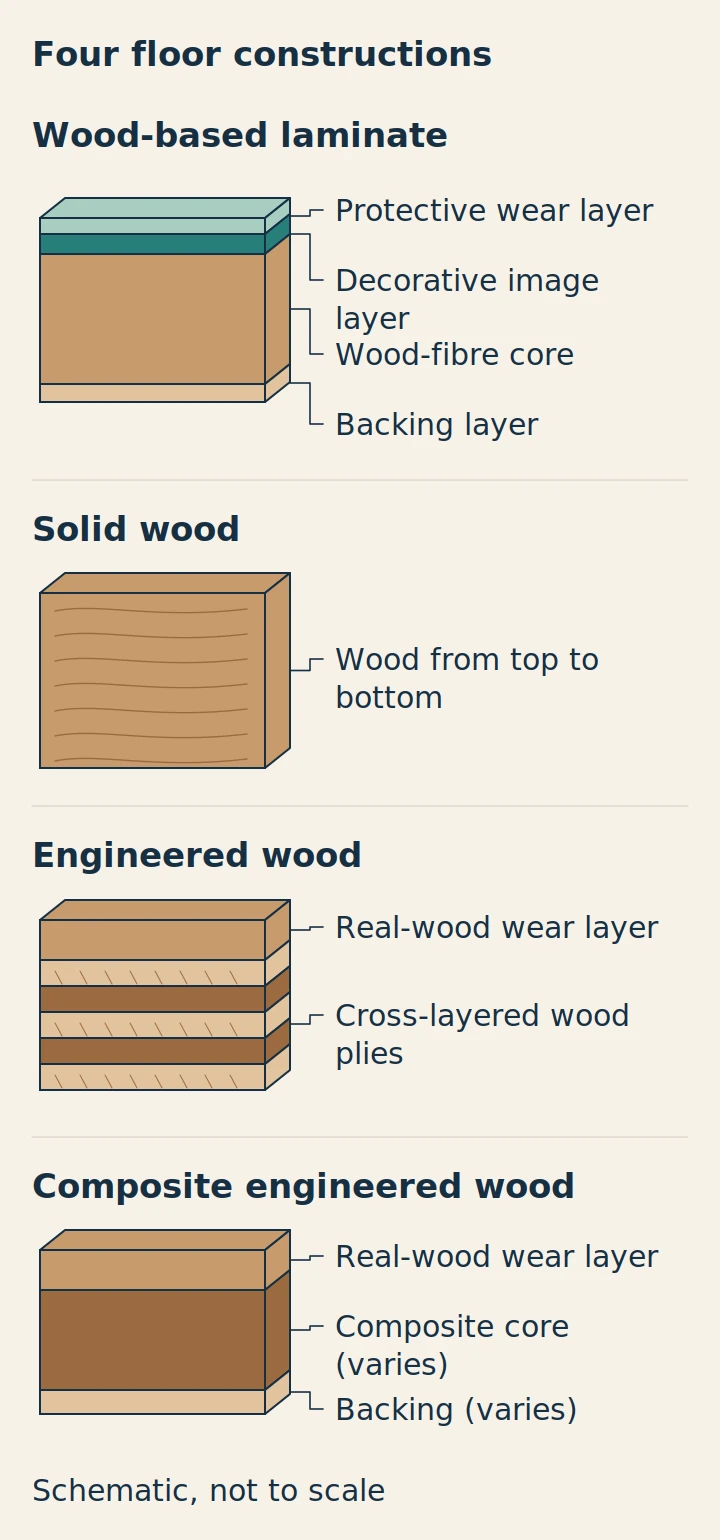
The North American Laminate Flooring Association (NALFA) describes laminate as a protective wear layer over a decorative layer of high-definition imagery, on a core of wood fibres compressed under heat and pressure, with a backing layer beneath. Underlayment is a separate installation layer, although some products have one attached. The National Wood Flooring Association (NWFA) defines a wood floor differently: any product with real wood as its top-most wearable surface. Its Refinishable Program document splits real wood flooring into three categories.
Scroll horizontally to view all columns.
| Construction | What the top surface is | What lies beneath | Source |
|---|---|---|---|
| Wood-based laminate | A clear protective layer over a printed decorative image | Compressed wood-fibre core and a backing layer | NALFA, “What is Laminate?” |
| Solid wood | Wood | The same piece of wood, top to bottom | NWFA Refinishable Program, definitions |
| Engineered wood | A real-wood wear layer | Wood veneers or slats glued in opposing directions | NWFA Refinishable Program, definitions |
| Composite engineered wood | A real-wood wear layer | A core and backing that may be any composite material | NWFA Refinishable Program, definitions |
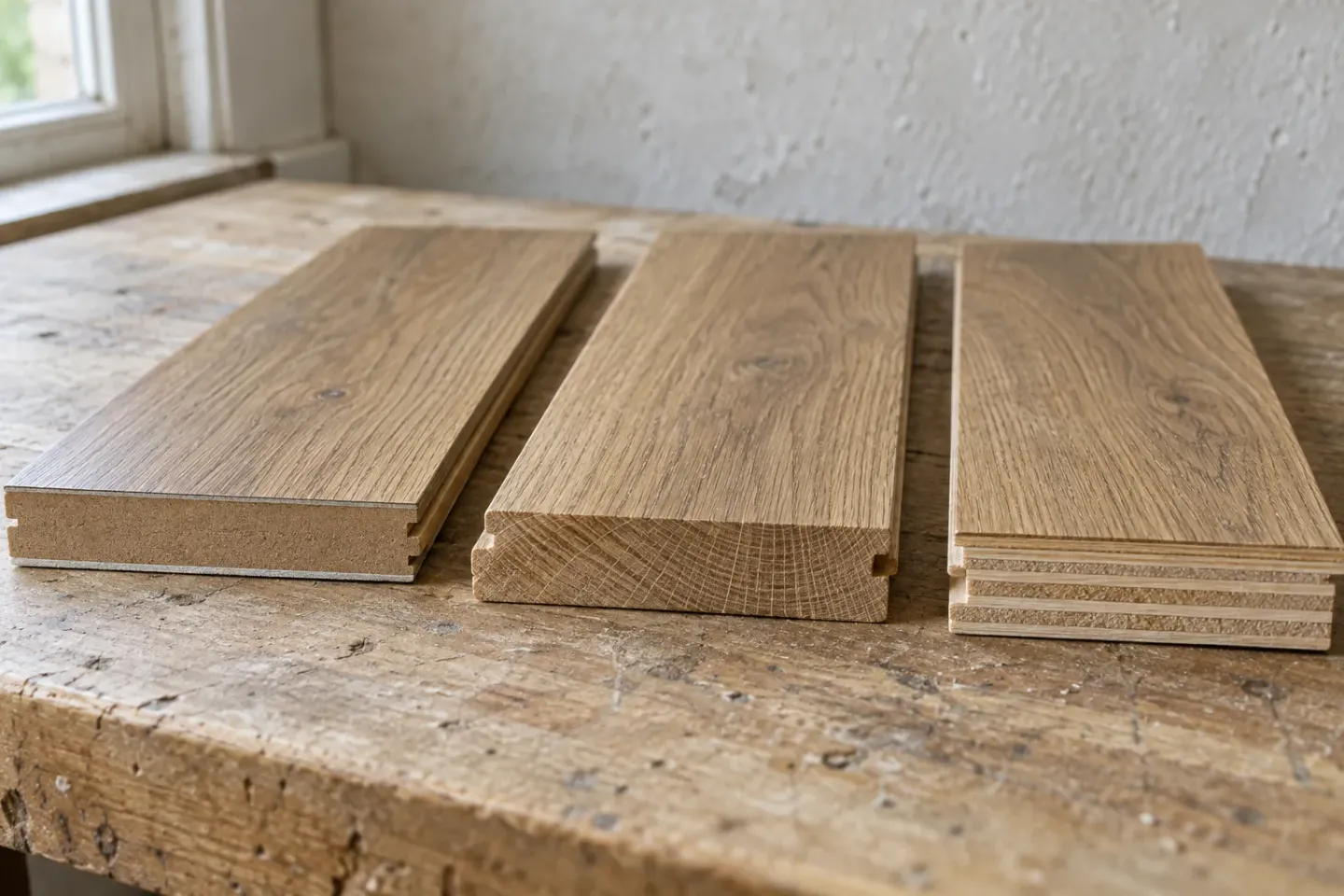
The last row matters when you read a product label. “Engineered” does not always mean wood all the way through; a composite core can look like fibreboard at the cut edge. Ask for the construction sheet rather than inferring the core from the face. Recording the material separately from its use, as in our guide to types of building materials, keeps those two descriptions from being confused.
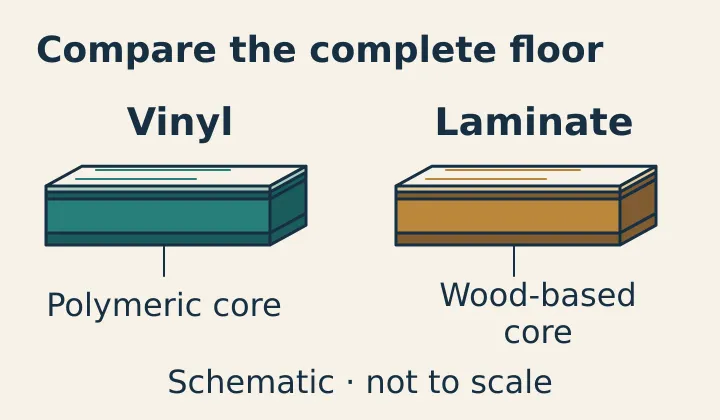
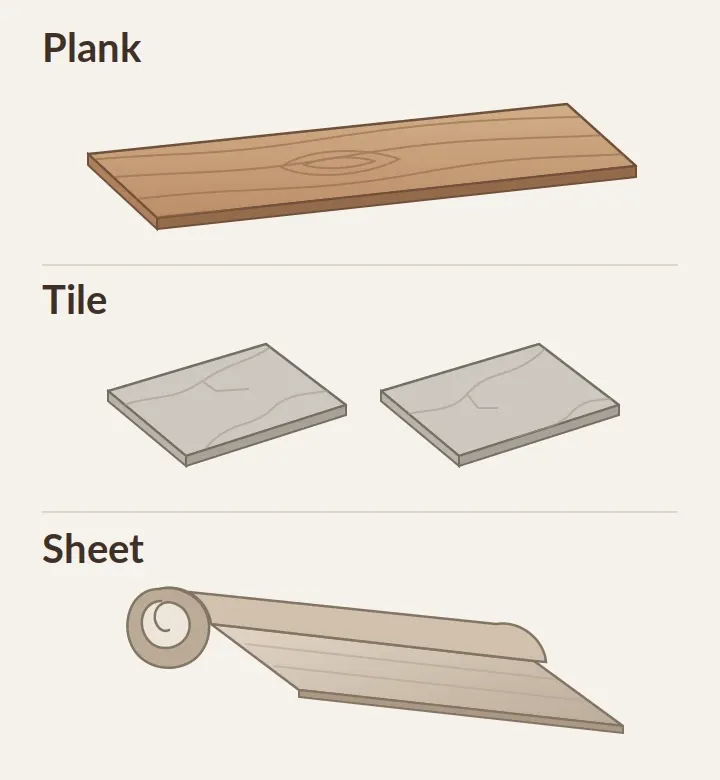
A wood-grain face does not identify the product either. If the plank you are considering is actually vinyl or a rigid-core “LVP”, it belongs to a different family: see the guide to vinyl plank, tile and sheet formats.
Takeaway: Laminate’s wood is an image; hardwood’s is real — but engineered wood can sit on a wood or a composite core, so read the construction sheet.
How is each floor repaired?
Repair routes follow from the construction. A printed image cannot be sanded back to fresh wood; a real-wood surface often can. The NWFA recommends that wood floor damage be evaluated by a certified professional, member or equivalent before a route is chosen, so treat the table as a way to frame that conversation rather than a diagnosis.
NALFA states that laminate floors do not require sanding or refinishing and that, if a plank becomes damaged, many systems allow it to be replaced. “Many” is the operative word: the replacement method depends on the locking system and the installation, and a good match depends on having spare boards from the same product.
For wood, the NWFA distinguishes a maintenance coat — cleaning the existing finish, lightly abrading it and applying a fresh coat of finish — from a complete sand and refinish, which it recommends for deep scratches, dents or where the finish has worn away to bare wood. Its installation guidelines describe surface scratches as typically only in the finish coats (“a fingernail can’t feel the ridge”) and deep scratches as going through the finish and tearing wood fibres.
The Source column names the document behind each row. Where it says “our advice”, no cited document sets that route and the entry is our editorial recommendation.
Scroll horizontally to view all columns.
| What you see | Laminate route | Solid wood route | Engineered wood route | Source |
|---|---|---|---|---|
| Surface scratch in the finish | Follow the product’s care and repair instructions | Isolation repair or maintenance coat | Isolation repair or maintenance coat | Laminate: our advice. Wood: NWFA Installation Guidelines, Repair, Part I-A (p. 153); NWFA, “Refinishing Your Floors” |
| Deep scratch, dent or gouge | Replace the plank where the system allows; otherwise follow the product’s repair instructions | Isolation repair, resand or board replacement | As solid, but resanding depends on the wood left | NALFA, “What is Laminate?”; NWFA Installation Guidelines, Repair, Part I-A and I-B (p. 153); NWFA, “Refinishing Your Floors” (wear layer) |
| Finish worn through to bare wood | Not applicable; the top layers are a clear wear layer and a printed image, not wood | Complete sand and refinish | Resand only if enough wear layer remains | NALFA, “What is Laminate?”; NWFA, “Refinishing Your Floors” |
| Water damage (cupping or buckling) | Find and fix the moisture source; the repair method has to come from the product’s instructions and warranty | Assess flooring, subfloor and room moisture first; route varies | Assess flooring, subfloor and room moisture first; route varies | Laminate: our advice (the 2018 Pergo warranty discussed below excluded leak and subfloor-moisture damage). Wood: NWFA Installation Guidelines, Repair, Part I-E (pp. 153–154) |
| A board that cannot be repaired | Replace the plank | Replace the board with a matching profile, grade and moisture content | As solid | NALFA, “What is Laminate?”; NWFA Installation Guidelines, Replacement, Part II (p. 154) |
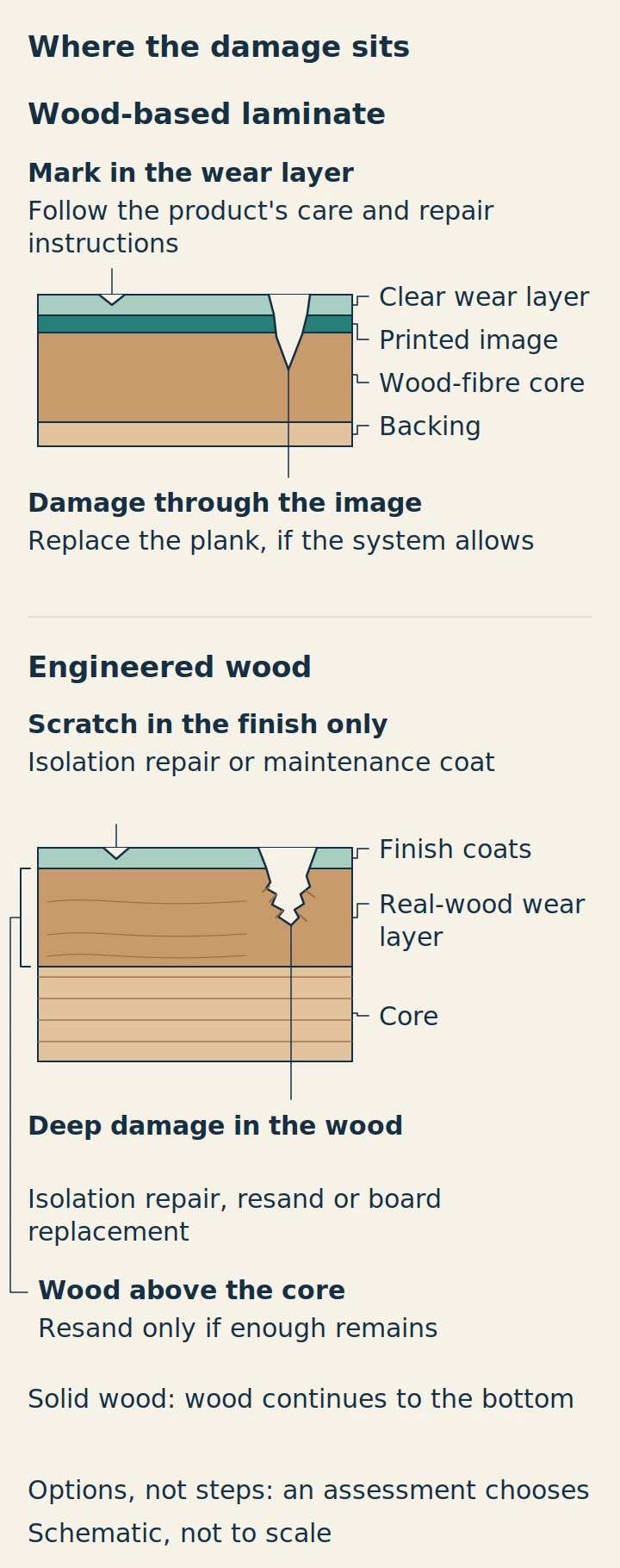
For a wood board replacement, the NWFA guidelines ask for matching profile, width, bevel, edge, cut and grade, and a moisture content within 2 percent of the existing flooring. That is a reason to keep a few spare boards in the house after installation, whichever floor you choose.
Common mistake: Treating a maintenance coat and a resand as the same job. A maintenance coat renews the finish; a resand removes wood. Ask which one is being quoted.
Takeaway: Laminate is repaired by replacing planks; wood adds recoating and resanding — so check spare stock and the approved method before you buy either.
When can engineered wood be sanded?
Only when the product and its current condition leave enough real wood to sand. There is no universal number of resands for engineered wood, or for solid wood. The NWFA says the number of times a floor can be sanded varies with the contractor’s skill, the equipment, the thickness of the wear layer, the flatness of the floor and its condition.
The NWFA Engineered Wood Flooring Refinishable Program is a voluntary certification designed to identify engineered products with wear layers thick enough to be refinished. Its June 2022 document sets minimum wear layers for eligibility — 3.2 mm for unfinished products and 2.5 mm for factory-finished products — and evaluates sculpted or distressed products individually. Those are entry criteria for certifying a new product. They do not tell you how much wood is left in a floor that has already been sanded, and a product’s absence from the list does not prove it cannot be refinished.
Before counting on a resand, establish four things:
- Construction: engineered on wood plies, or composite engineered on another core.
- Refinishability evidence: the manufacturer’s statement or a program listing for that exact product.
- History: whether and how often the floor has been sanded.
- Condition: flatness, damage depth and the professional’s view of the wood remaining.
Common mistake: Assuming every engineered floor can be sanded because it has a real-wood surface. A thin or previously sanded wear layer may allow only a recoat — or no further sanding at all.
Takeaway: Treat resanding engineered wood as a product-and-condition question, not a category feature.
Should you cover existing hardwood with laminate?
This is a separate decision from choosing between two new floors. A common version of it: an older hardwood floor needs work, and laying laminate over it, perhaps to match an adjoining kitchen, looks simpler. Restoring the wood and covering it are both possible routes, and neither is the default.
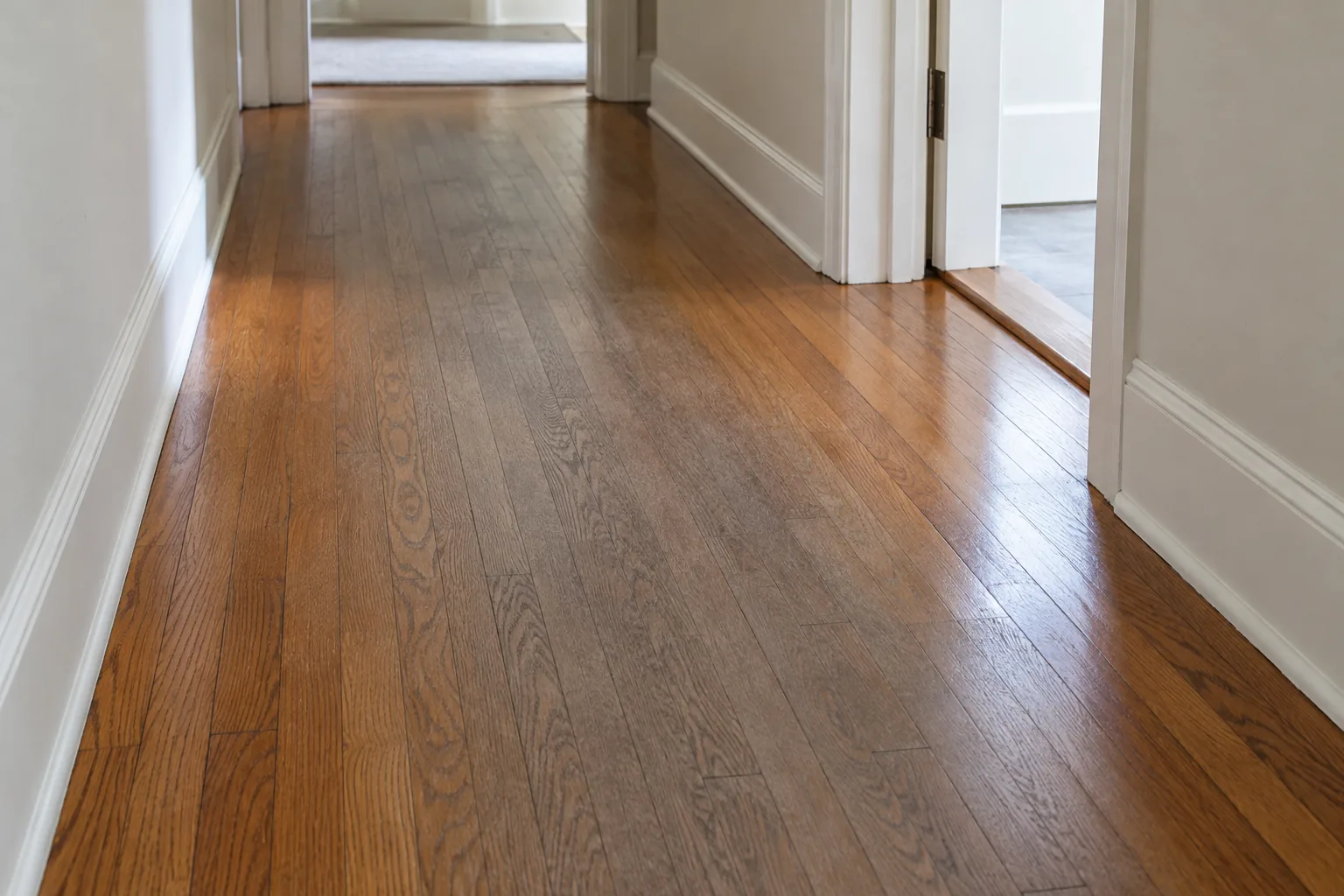
NALFA’s list of suitable subfloors includes existing hardwood, described as “viable if the hardwood is stable and flat”, with a check of older floors for warping or damage. It lists existing bamboo or laminate as unsuitable bases for new laminate. That makes the wood’s condition the first input either way: a stable, flat floor with a worn finish may be a candidate for a maintenance coat or resand, and is also a possible base for laminate if the selected product’s instructions permit it.
Before deciding, record:
- The proposed new floor: is it laminate, or a vinyl plank sold under a similar name? Those have different documents; the vinyl vs laminate comparison covers that choice.
- The existing wood: solid or engineered, flatness, any warping or damage, and whether the problem is the finish or the wood.
- Restoration scope: what a wood flooring professional proposes (maintenance coat, resand or board repair) after inspection.
- Covering scope: underlay, the change in floor height at doors and transitions, trim, and what the laminate instructions say about this base.
Takeaway: Assess the existing wood first; then compare restoring it with covering it as two complete scopes.
How do moisture and warranty limits differ?
For both floors, moisture tolerance and room approval belong to the named product, not to the category. What differs is where the controlling instruction sits and what you are asked to record.
For laminate, NALFA says the product suits most interior rooms but not outdoor use or areas with excessive moisture, such as bathrooms and saunas, unless the manufacturer specifies it as waterproof. For below-grade concrete it advises vigilance about moisture and avoiding floors with drains. For wood, the NWFA installation guidelines say that a manufacturer’s recommendations for a specific product supersede the NWFA’s, and ask installers to test and document the temperature and relative humidity in each room; for factory-finished solid and engineered flooring, the manufacturer’s requirements apply. For engineered wood they ask for jobsite ambient conditions and subfloor moisture to be checked and recorded against the selected flooring’s requirements before delivery.
Scroll horizontally to view all columns.
| Record | Laminate | Hardwood (solid and engineered) |
|---|---|---|
| Permitted rooms | Manufacturer’s statement for the exact range | Manufacturer’s installation instructions |
| Ambient conditions | As the product’s instructions require | Measure and record temperature and humidity in each room |
| Subfloor moisture | Moisture test as the instructions and warranty require | Check and record against the product’s requirements |
| Wet events | Read warranty exclusions for floods, leaks and moisture below the floor | Assess with a professional; water damage is handled case by case |
A dated example shows how narrow a laminate water claim can be. The Pergo Portfolio + WetProtect US floor warranty dated December 2018 covered resistance to damage from wet mopping and everyday household spills. It made coverage conditional on proper installation, including a subfloor moisture test, and excluded damage from flooding, standing water, leaking pipes, mechanical failures or appliance leaks, and moisture in or beneath the subfloor. That document illustrates how to read a warranty; it is not the contract for a floor bought today, and it does not show that laminate as a class is waterproof. For how vinyl and laminate water warranties compare across several dated documents, see our water-and-wear comparison of vinyl and laminate.
Durability evidence is similarly specific. NALFA’s LF-01 standard tests separate properties — static load, thickness swell, impact and wear among them — at usage levels from residential to heavy commercial. The official download carries a 2019 foreword and an LF-01-2018 table heading; in May 2026 NALFA reported Board-approved proposed updates entering canvassing and public review, not a newly issued edition. None of these results converts into a single laminate-versus-hardwood durability score.
Takeaway: Collect the product’s room permission, moisture records and dated warranty; a category label answers none of them.
When this does not apply
This comparison stops where the room, the building or the existing floor needs its own assessment:
- Rooms with floor drains, showers or standing water: use only a product whose documents expressly cover that exposure, and have the assembly beneath it assessed.
- Existing water damage or an active leak: find and fix the moisture source first; the NWFA treats water-damaged wood case by case.
- Outdoor, unheated or seasonal spaces: NALFA excludes outdoor use for laminate; check the wood product’s ambient requirements.
- Commercial specifications: the dated warranty above gave residential and light-commercial uses different terms; obtain the documents for the actual use.
- Old floors with unknown coatings or adhesives: have them identified before sanding or removal; this guide is not a removal procedure.
Takeaway: If one of these applies, resolve it before choosing between laminate and wood.
What should you verify before buying?
Fill in one column per real candidate. “Not supplied” is a valid entry — it shows what is still unresolved, rather than letting an assumption fill the gap. The last column names the document a requirement comes from; “our advice” marks an editorial recommendation.
Scroll horizontally to view all columns.
| Field | Laminate evidence | Hardwood evidence | Basis |
|---|---|---|---|
| Product and reference | Range, decor and SKU | Species, range and SKU | Our advice: similar names can cover different constructions |
| Construction | Construction sheet; attached underlay or not | Solid, engineered or composite engineered; core material | NALFA, “What is Laminate?”; NWFA Refinishable Program definitions |
| Wearable surface and refinishing | Not applicable (printed layer) | Wear-layer statement; program listing if claimed; sanding history for an existing floor | NWFA, “Refinishing Your Floors”; NWFA Refinishable Program |
| Repair method and spares | Approved plank-replacement method; spare boxes from the same lot | Board-replacement approach; spare boards | NALFA, “What is Laminate?”; NWFA Installation Guidelines, Replacement, Part II (p. 154); spare stock is our advice |
| Room and moisture records | Permitted-room statement; subfloor moisture test where the instructions or warranty require it | Room temperature and humidity; subfloor moisture | NALFA laminate FAQs (rooms); NWFA Installation Guidelines, Jobsite Conditions, Part IV (p. 32) and Acclimation/Conditioning, Part II (p. 36); the 2018 Pergo warranty made a subfloor moisture test a condition |
| Installation | Instructions, underlay and transitions | Instructions, fastening or adhesive method, finish system | NWFA Installation Guidelines, introduction: a manufacturer’s recommendations for a specific product take precedence; for laminate, our advice |
| Warranty | Current document for the product and territory, with exclusions | Current document for the product and territory, with exclusions | Our advice, illustrated by the 2018 Pergo warranty: conditions and exclusions belong to one dated document |
Compare the completed columns, not the photographs. Our collection of material comparisons applies the same document-first approach to other finishes, and the index of individual material guides covers other material families.
Takeaway: Buy the candidate whose documents match your room and repair expectations; resolve every “not supplied” line first.
Related reading
- Vinyl vs laminate: water and wear — if the shortlist includes vinyl or rigid-core plank.
- Vinyl flooring formats — to tell plank, tile and sheet vinyl apart.
- How to choose building materials — to set room requirements before comparing products.
Method and sources
We compared NALFA’s construction page, FAQ and LF-01 download, its May 2026 revision notice, the NWFA’s refinishing page, Refinishable Program document and installation guidelines (revised 2025), and one Pergo warranty dated December 2018. All were read on 11 October 2026. Association guidance is not a building code, and manufacturer instructions for a specific product take precedence over it. We did not test, install or price any floor; no product named here is endorsed or ranked. This article was prepared with AI assistance and editorial source review.
The first three FAQ questions appear as written in US Google search results for “laminate flooring vs hardwood” on 11 October 2026 (two People Also Ask questions and one Quora question title). The fourth is our question form of a related search, “laminate flooring vs hardwood cost”. The covering-existing-hardwood section responds to a situation described in a Reddit r/HomeImprovement thread; we paraphrase it rather than quote it.
Our editorial policy and fact-checking and corrections policy explain how sources are selected and checked, and the AI use policy explains how AI assistance is used and reviewed. If a document cited here has changed or you find an error, please contact the editors.
Frequently asked questions
Do laminate floors look like real wood?
They can look very close, because the decorative layer is a high-definition image of wood under a clear protective layer. It is still an image, not a wood surface: the NWFA defines a wood floor by real wood on the top wearable surface. Judge the look on a full-size sample in the room's light, and check the construction sheet for what lies beneath.
What is the downside to laminate flooring?
Its surface cannot be sanded back the way a real-wood floor can, so deeper damage is normally handled by replacing planks, which depends on the locking system and matching spares. Water suitability also varies: NALFA says laminate is not for areas with excessive moisture unless the manufacturer specifies it as waterproof. Read the exact range's documents.
What are the advantages of laminate versus hardwood flooring?
Laminate does not require sanding or refinishing, and many systems allow a damaged plank to be replaced. Hardwood's advantage is a real-wood surface that can be recoated or, with enough wood left, resanded. Which matters more depends on your room, how you expect the floor to be damaged and repaired, and the documented product, not on a category ranking.
How should you compare laminate and hardwood costs?
Compare complete scopes rather than material prices. List subfloor preparation, removal of the existing floor, underlay, transitions and trim, installation, and the future repair route: plank replacement and spare stock for laminate; recoating or resanding for wood. Ask each supplier to price the same scope. This guide does not quote prices.
Sources
- What is Laminate? Laminate construction layers — North American Laminate Flooring Association (NALFA) Accessed October 11, 2026.
- Laminate Flooring FAQs and suitable subfloors — North American Laminate Flooring Association (NALFA) Accessed October 11, 2026.
- Refinishing Your Floors — National Wood Flooring Association (NWFA) Accessed October 11, 2026.
- Engineered Wood Flooring Refinishable Program, June 2022 — National Wood Flooring Association (NWFA) Accessed October 11, 2026.
- Wood Flooring Installation Guidelines, revised 2025 — National Wood Flooring Association (NWFA) Accessed October 11, 2026.
- Pergo Portfolio + WetProtect limited warranty for floor installations, December 2018 US document — Pergo Accessed October 11, 2026.
- NALFA/ANSI LF-01 laminate flooring standard, official download — North American Laminate Flooring Association (NALFA) Accessed October 11, 2026.
- NALFA advances LF-01 updates, 18 May 2026 — North American Laminate Flooring Association (NALFA) Accessed October 11, 2026.