At a glance
Scroll horizontally to view all columns.
| Criterion | Vinyl flooring | Wood-based laminate flooring |
|---|---|---|
| Core and construction | Flexible vinyl and rigid polymeric-core products are different constructions | Wood-based core with decorative and protective surface layers |
| Water claim | Read the named product warranty and exclusions for moisture below or around the floor | Water-resistant ranges exist; permitted rooms and sealing conditions vary |
| Wear evidence | Wear-layer details plus the applicable product specification and test results | Abrasion classification plus other required performance results |
| Installation | Product-specific glued or floating system and prepared substrate | Product-specific locking system, movement space and approved underlay |
| Selection basis | Exact construction, room, documents and installer assessment | Exact construction, room, documents and installer assessment |
Vinyl and laminate flooring should be compared as specific floor systems, not as two universal waterproof ratings. Choosing from the label alone can leave you with a floor that excludes the very moisture problem, room or cleaning method you need it to tolerate.
This comparison covers flexible vinyl planks, rigid SPC-type vinyl and wood-based laminate. It does not rank brands or treat a historical warranty as the contract for a new purchase. Start with your room and the exact product reference, then check the dated documents attached to that reference. Our building-material selection guide provides the wider process for turning those requirements into a shortlist.
Compare the core before comparing the finish
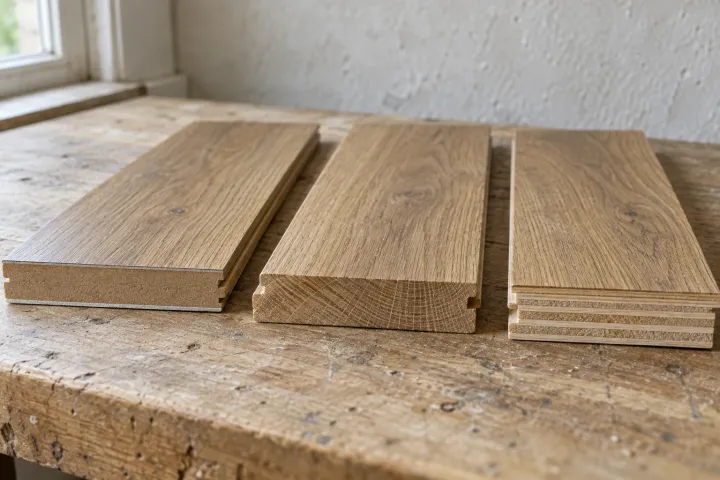
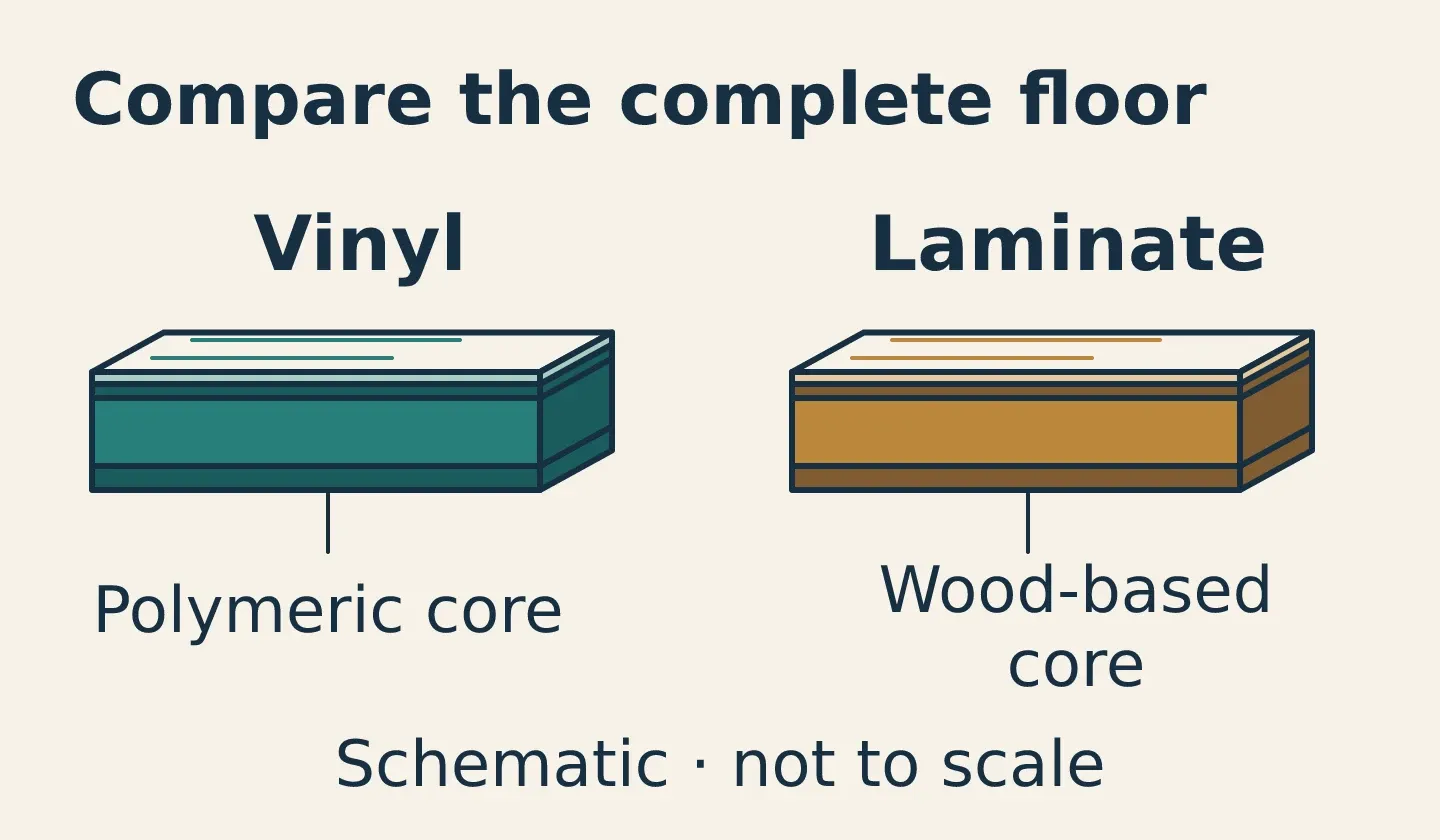
A wood-grain image tells you little about what lies beneath it. Vinyl and laminate can both have a printed decorative surface, but their core materials and layer arrangements differ. The product’s construction drawing is a more useful starting point than the showroom photograph.
Flexible vinyl planks use a vinyl-based body. Rigid SPC-type products belong to a different construction family with a rigid polymeric core; their name should not be used as a synonym for every vinyl plank. ASTM F3261 describes modular flooring built around that rigid core, while F1700 covers solid vinyl products in modular tile or plank formats. A supplier’s “LVP” label alone does not identify which specification applies.
NALFA describes laminate as a layered product with a wood-based core, a decorative layer and a protective surface, with a balancing layer beneath. Attached backing and proprietary surface treatments vary. Ask whether the quoted thickness includes an attached pad and whether the illustrated layer arrangement is actually for the product being supplied.
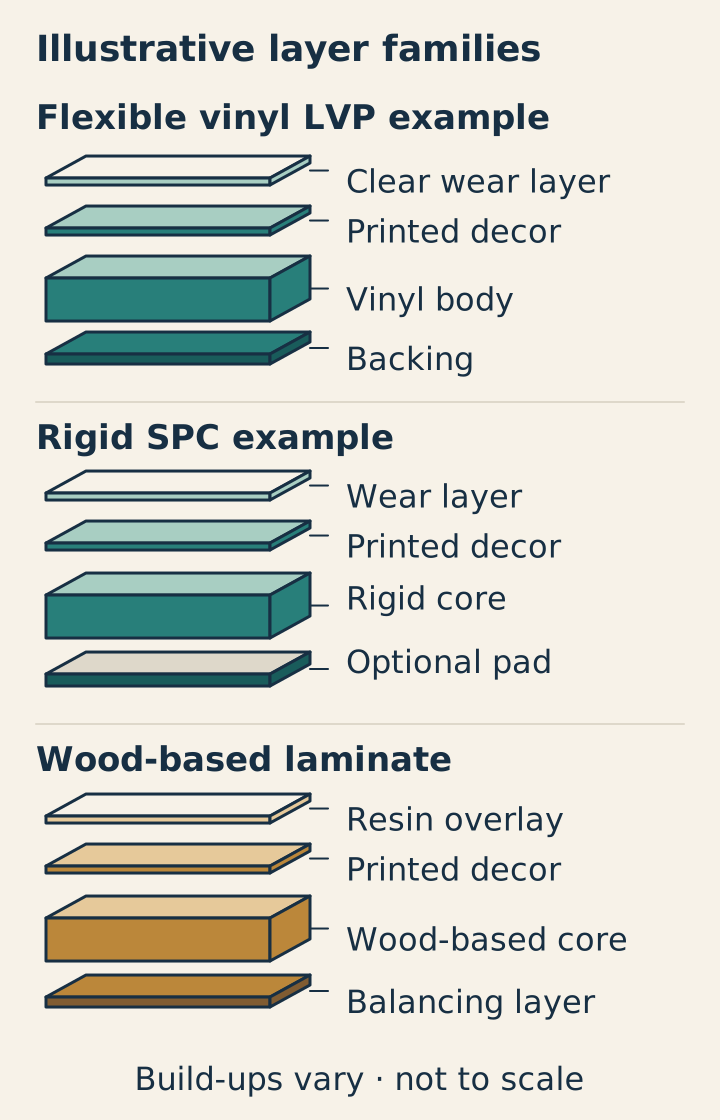
Keep three descriptions in your comparison sheet: material construction, installation method and intended application. Those describe different things. A click joint does not turn a wood-based core into vinyl, and a polymeric core does not tell you whether the product is approved for the proposed room. The broader types-of-building-materials guide explains why material identity and building function should be recorded separately.
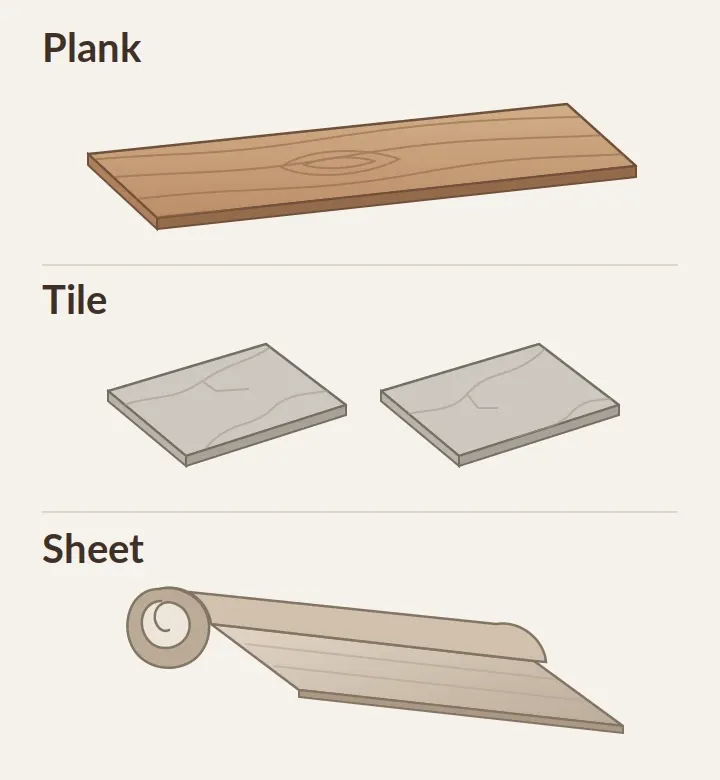
For the distinction between plank, tile and sheet formats within vinyl itself, use the vinyl flooring types and limitations guide.
If real wood is also on your shortlist, the laminate versus hardwood comparison explains how a printed laminate surface differs from solid and engineered wood when the floor needs repair or refinishing.
Takeaway: Compare the exact build-up and product reference before using appearance, plank thickness or a retail category as a proxy for performance.
Check which standard the product actually cites
Standards answer different questions. Some define a product family and its requirements; another classifies intended use. A standard number on a brochure is a starting point for checking the manufacturer’s evidence, not proof that every possible floor installation is suitable.
We checked the following publisher records on 7 October 2026. Public catalogue descriptions establish scope and publication status; they are not a substitute for the complete purchased ASTM, EN or ISO requirements when writing a project specification.
Scroll horizontally to view all columns.
| Document | Status checked for this guide | What to ask the supplier |
|---|---|---|
| ASTM F1700-25 | ASTM lists it as active; solid vinyl flooring in modular tile or plank format | Does this exact product claim conformity, and where is its supporting declaration or report? |
| ASTM F3261-26 | ASTM lists the 2026 edition as active, updated 9 September 2026 | Is this a rigid polymeric-core product, and which edition is on its documentation? |
| EN 13329:2023 | BSI lists its BS EN adoption as current, published January 2024 | Which laminate performance classification and supporting tests are declared? |
| ISO 10874:2009, with Amendment 1:2020 | ISO lists the published edition as current and under revision; the amendment removes class 22+ | Which use class applies, and what product-specific requirements support it? |
| NALFA LF-01 | The current official download refers to the 2019 publication in its foreword; NALFA’s May 2026 notice describes approved proposals proceeding to canvassing and public review | Request the applicable revision and certification record; do not relabel the available document “LF-01:2026” |
ISO 10874 concerns area and intensity of use. It does not make unlike materials identical or replace a manufacturer’s room restrictions. Equally, an old test document is not automatically invalid because the publisher has issued a newer edition: establish what the project requires and ask the manufacturer to explain the basis of its declaration.
For an unfamiliar claim, record the document title, edition, product identity, issuing organisation and relevant result. Our fact-checking policy describes the source-verification approach used here. An undated sales chart cannot resolve a conflict between an installation instruction and a warranty exclusion.
Takeaway: Match the standard’s scope and edition to the named product; distinguish a published revision from a proposal or a marketing shorthand.
Read water resistance as a bounded product claim
There are at least three separate questions: what happens to the plank surface after a spill, what happens at the edges and joints, and what happens beneath the floor. A favourable answer to the first does not establish a waterproof room assembly.
The examples below are deliberately dated. They illustrate how to read a warranty, not which product to buy today. Product ranges, terms and territories can change; obtain the document supplied for your actual purchase.
Scroll horizontally to view all columns.
| Document example | Stated protection or condition | Boundary that changes the decision |
|---|---|---|
| Pergo Portfolio + WetProtect, December 2018 US document | Addresses ordinary household spills and wet mopping, subject to installation and care conditions | Its exclusions include flooding, standing water, plumbing or appliance leaks, and moisture beneath the flooring |
| COREtec Galaxy, August 2021 residential warranty | Describes topical moisture protection with conditions at room edges and cut boards | Excludes specified excessive subfloor moisture and floods; the floor covering does not resolve a building moisture problem |
| Quick-Step laminate, June 2024 UK document | Its table assigns water-resistance coverage to particular ranges; certain wet-area installations are conditional | Excludes specified events including floods and plumbing failures, and moisture between laminate and subfloor; shower rooms with built-in drains are excluded |
The two laminate documents also show why “laminate can never go in a bathroom” and “all waterproof laminate can go anywhere” are both poor purchase rules. Read the named range’s permitted application and the installation details. Do not carry an allowance from a UK product document into a US product with a similar-looking name.
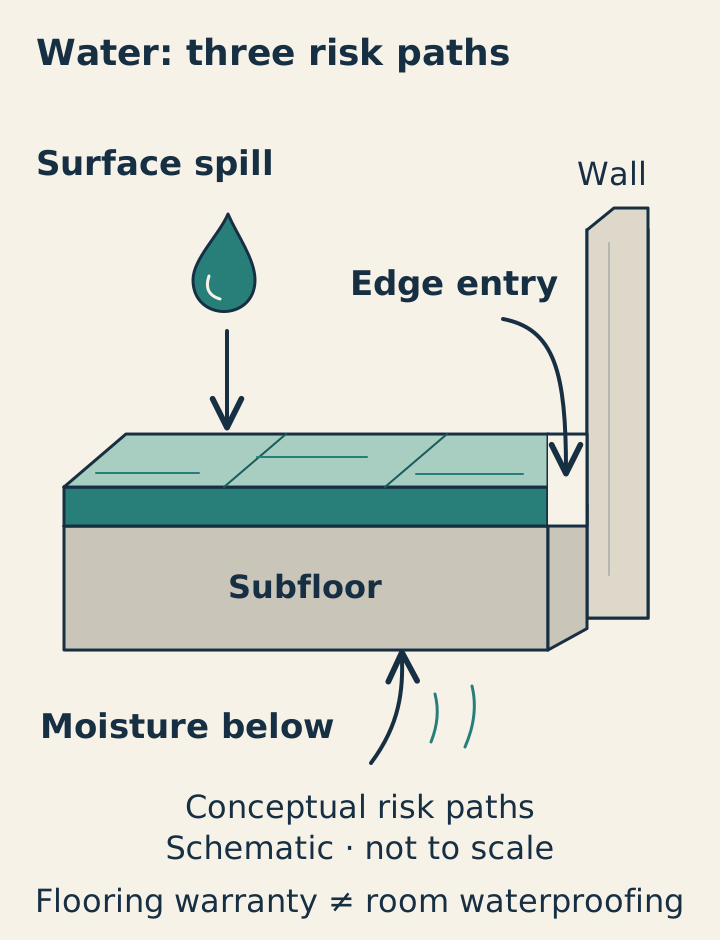
For a bathroom, describe the exposure before selecting either material: routine splashes, water tracked from bathing, an existing leak, or a room designed with a drain. Those are not interchangeable conditions. Ask what protects the building beneath the finish and who has assessed that assembly. If a tile or slab alternative enters the shortlist, the porcelain-versus-natural-stone comparison is a separate material decision; it is not evidence that any floor covering alone waterproofs the room.
A useful approval record has the product reference, room description, installation document and warranty together. If the retailer says an excluded use is acceptable, ask for clarification from the manufacturer rather than treating the retailer’s reassurance as an amended document.
Takeaway: A water claim belongs to a product, an exposure and a set of conditions. It is not a blanket property of vinyl or laminate.
Separate abrasion, scratches and dents
“Hard-wearing” can refer to several different kinds of damage. Surface material gradually wearing away, a scratch from grit and a dent beneath a loaded furniture foot are different mechanisms. A single marketing adjective cannot tell you how a floor performs in all three.
NALFA LF-01 treats wear, impact and static load as separate performance subjects. That distinction matters when discussing an AC abrasion classification for laminate. Do not translate an AC label directly into a vinyl wear-layer thickness, a scratch guarantee or years of service. Ask which test and product classification the supplier is actually citing.
For vinyl, request the wear-layer information alongside the applicable performance declaration. For laminate, request the stated abrasion classification together with the rest of the intended-use evidence. In both cases, confirm whether the document covers the complete product being bought, rather than another thickness or range.
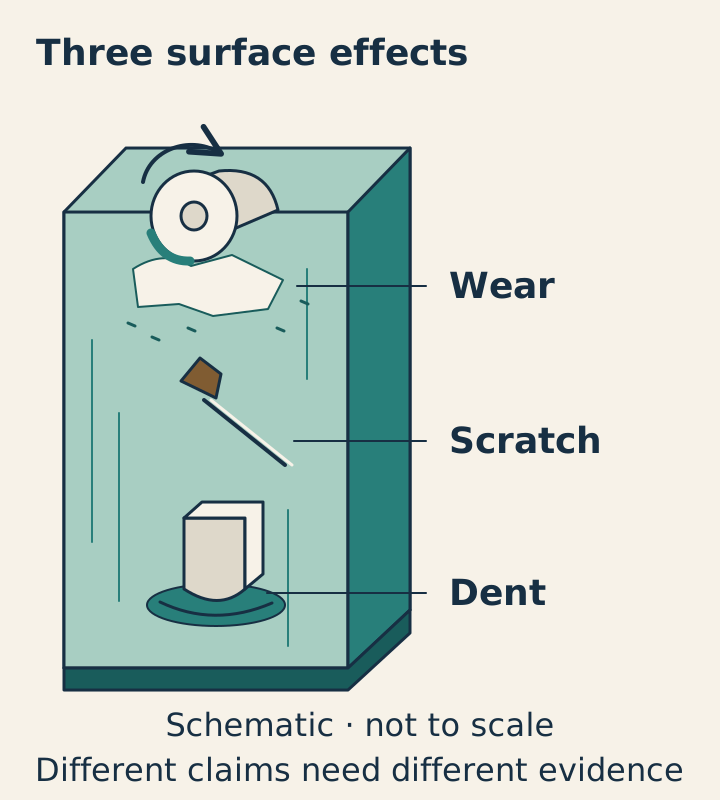
Write the actual loads into the room brief: grit at an entrance, dining chairs moved daily, a rolling office chair, or heavy furniture that will remain in place. Then check the manufacturer’s protection and maintenance conditions for that use. The useful question is whether the documented product fits the room, not which category wins an abstract durability contest.
Our material comparison collection follows the same principle across other building products: compare like evidence and preserve the conditions attached to each result. A table can organise the questions, but it cannot create a common test where none has been supplied.
Takeaway: Treat abrasion, scratching and indentation separately; do not convert unlike ratings into an invented overall durability score.
Include the subfloor and installation in the comparison
A shortlist is incomplete until someone has assessed the existing floor. Record the substrate material, its condition, any moisture history, the intended installation method and the preparation work required. Compare the resulting assemblies rather than two plank prices.
Shaw’s published SPC installation guidance requires a suitable, clean, dry and flat substrate and addresses moisture testing. It also warns that soft substrates can compromise locking performance. These are reasons to obtain product-specific requirements, not universal tolerances for every vinyl floor. We do not reproduce one system’s moisture limit as a limit for the whole category.
Laminate installation likewise needs its own instructions. The dated Pergo example requires moisture assessment and specified perimeter treatment; the Quick-Step document links water-resistance coverage to approved installation details. Mixing the accessories and procedures from different brands creates an assembly that neither source has described.
Use a scope sheet to make the comparison reviewable:
Scroll horizontally to view all columns.
| Record before ordering | Why it belongs in the comparison |
|---|---|
| Exact plank and backing reference | Similar names can cover different constructions |
| Floating or bonded method | Determines which installation document and accessories apply |
| Subfloor assessment and dated test records | Separates existing conditions from assumptions |
| Preparation, transitions and movement provisions | Prevents an incomplete supply-only comparison |
| Room restrictions and care document | Establishes whether the intended use fits the product |
| Written questions still unresolved | Keeps uncertainty visible before purchase |
If the existing finish must be investigated, do not assume removal is an ordinary sanding job. Shaw’s instructions flag the possible presence of hazardous materials in old resilient flooring and adhesives. Arrange appropriate identification and assessment before disturbing an unknown layer; this comparison is not a removal procedure.
The site’s materials directory is organised around individual products and families. Specifications from a wall panel or another finish do not transfer to flooring simply because a similar polymer, fibre or mineral appears in its description.
Takeaway: Put substrate assessment, preparation and the approved installation system into the decision before ordering the planks.
Check care instructions before choosing the floor
A floor has to suit the way the room will be maintained. Obtain the actual care document and compare it with the cleaning tools and routines already used in the building. Ask about the permitted cleaner, wet cleaning, steam, furniture protection and treatment of accidental spills.
The dated documents show meaningful differences. Pergo’s 2018 example excludes damage associated with steamers, while Quick-Step’s June 2024 UK terms describe conditional steam-cleaner use for particular water-resistant laminate with pressed bevels. Those statements are not interchangeable, and neither gives permission to steam-clean an unidentified floor.
Keep the cleaning instructions with the product record rather than relying on a general online tip. A cleaning contractor should receive the same approved method as the owner. If a necessary routine is prohibited, that is a selection issue to resolve before installation, not a reason to ignore the restriction afterwards.
For readers considering a mineral finish instead, our porcelain slab guide addresses that separate material family. Its requirements should be assessed independently; a change of material does not remove the need to check substrate, installation and care.
Takeaway: Select a floor whose documented care method fits the intended operation; “waterproof” is not permission for every cleaning process.
Make the choice with a short evidence checklist
Start with two actual candidates, not two generic categories. For each one, put the product sheet, installation instructions, warranty and maintenance instructions in the same folder. Note their dates and territory. Highlight contradictions and ask for a written product-specific answer before treating the issue as resolved.
A dry, climate-controlled bedroom may leave appearance, documented use suitability and care preferences to decide the shortlist. A bathroom adds room approval and water-exposure questions. A space with known moisture beneath its existing finish needs investigation before either category can be accepted. These are decision sequences, not claims that one material automatically passes.
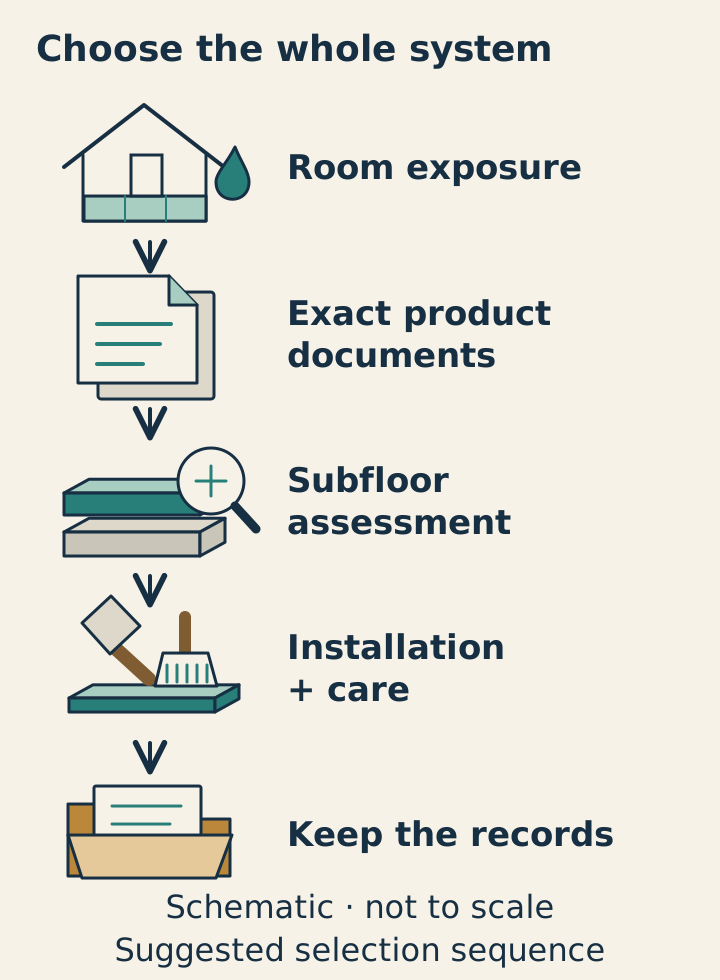
Keep an explicit “not supplied” field for missing information. Do not infer a test result from a product photograph, an AC number from total thickness, or bathroom approval from the word waterproof. This follows our editorial policy: sourced statements and editorial guidance serve different purposes.
Takeaway: Choose the candidate with documented suitability for your room and complete installation scope; resolve missing evidence before committing.
Frequently asked questions
Can I reuse laminate underlay beneath a vinyl floor?
Do not assume the two are interchangeable. Quick-Step’s published answer rejects laminate underlay for its vinyl because thickness and compressive strength differ. Identify the vinyl range, including any attached backing, and use its approved underlay arrangement. This also prevents an extra cushioning layer being added merely to raise the finished floor level.
What changes if the room has underfloor heating or cooling?
Check the floor and heating-system instructions together. Quick-Step’s vinyl guidance specifies low-temperature systems, a contact-temperature limit and total thermal-resistance considerations; cooling also needs condensation control. Ask the installer to document compatibility for the selected floor-plus-underlay assembly. A permission for one brand’s vinyl is not permission for every laminate or vinyl product.
Can the same plank continue into an unheated veranda?
Indoor moisture resistance does not establish temperature suitability. Quick-Step’s vinyl FAQ excludes verandas and other unheated applications in the range described. Make the unheated area a separate room condition when asking about either candidate. Do not infer approval from the fact that the neighbouring heated room uses the same plank.
Can I run a floating floor continuously through several rooms?
Obtain the selected system’s maximum-run and transition requirements. Quick-Step’s Alpha Vinyl answer varies its guidance with room temperature conditions and identifies rooms with different heating or cooling arrangements as a reason for an expansion joint. Draw the connected rooms and their controls for review instead of borrowing a single maximum length from another installation.
Does one damaged plank mean replacing the whole floor?
Not necessarily. Quick-Step publishes a replacement method for damaged vinyl click planks, but it involves that product’s joint and repair procedure. Keep spare product identification and ask whether a matching replacement and an approved method remain available. Do not assume a repair video for another locking system can be applied to your laminate or vinyl floor.
Is a dark scuff mark the same as surface wear?
A mark on the surface and material removed from it are different observations. Quick-Step provides a separate vinyl scuff-removal answer, which is why a mark should be assessed before being described as wear-through. Follow the selected product’s approved cleaning instructions first; if damage remains, document its location and appearance for the supplier rather than using an abrasive treatment to test it.
Sources and method
The six FAQ topics come from Quick-Step’s publicly available questions and full answers on underlay, heating/cooling, verandas, maximum floor length, plank replacement and scuff removal. They provide real application questions; the answers above retain their product-specific limits.
The standards table reports publisher status checked on 7 October 2026. ASTM, EN and ISO catalogue access does not mean we examined every clause of the paid standards. NALFA’s official LF-01 download was read directly, and its revision notice is distinguished from a newly issued edition. The older Pergo and COREtec warranties and the UK Quick-Step warranty are clearly dated examples, not a promise about current products in every market.
This article was prepared with AI assistance and source review. This guide does not supply prices, certify an installation or report our own durability or water test. Original diagrams explain the comparison; they are not manufacturer-approved construction details.
Sources
- ASTM F1700-25 public scope and status
- ASTM F3261-26 public scope and status
- BS EN 13329:2023 current catalogue record
- ISO 10874:2009 status and amendment
- NALFA LF-01 official download
- NALFA May 2026 revision announcement
- Pergo Portfolio WetProtect warranty, December 2018 example
- COREtec Galaxy residential warranty, revision August 2021
- Quick-Step UK laminate warranty, June 2024
- NALFA laminate construction
- Shaw SPC installation guidance
- Quick-Step published vinyl questions