Replacing a damp floor before finding the water source risks repeat damage beneath the new finish. Separate surface water, room humidity and subfloor moisture before choosing a repair. Then identify the floor system and compare the appropriate test results with its installation and adhesive documents.
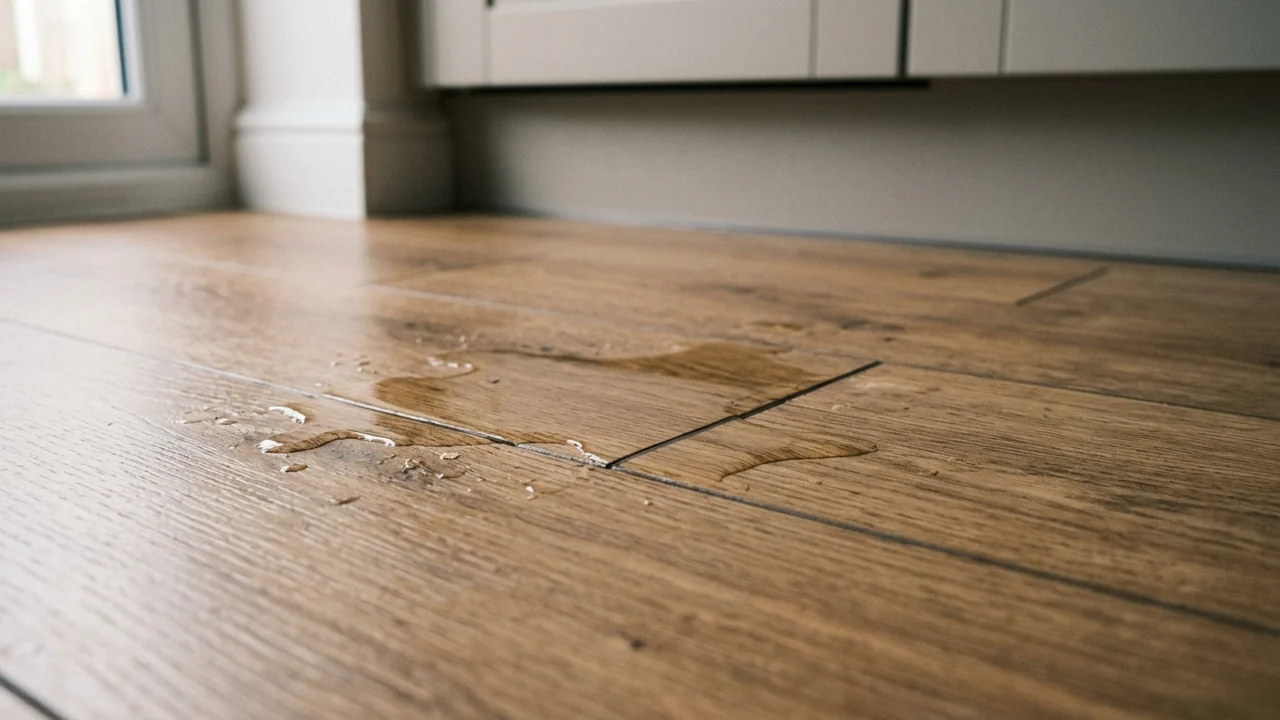
This guide helps organise an investigation of an existing indoor floor or a substrate awaiting replacement flooring. It does not diagnose concealed damage from a photograph, set a universal moisture limit, or prescribe a drying period. Use the record below to make the next inspection answer a specific question.
Start with the possible source, then choose the investigation
Several sources can coexist. A spill may explain the first visible wet patch while the substrate still needs investigation. Treat the following branches as questions to close, rather than diagnoses made from appearance.
On a narrow screen, swipe the tables to see the remaining columns.
Scroll horizontally to view all columns.
| Possible source | What to record first | Investigation to discuss with the installer | What would remain unanswered |
|---|---|---|---|
| Water arriving on top: spills or a plumbing/appliance leak | Where water appeared, when it started, nearby fixtures, photographs and whether it recurs | Locate and correct the source; assess which floor layers were affected | Whether the substrate is ready to receive the replacement floor |
| Indoor humidity affecting wood | Room temperature and air RH over time, heating/cooling operation, seasonal timing and board changes | Ambient logging alongside suitable wood-floor and wood-subfloor moisture measurements | Concrete moisture below a wood assembly, or a concealed leak |
| Moisture within or below the substrate | Substrate identity, slab or crawlspace information, previous test reports and affected locations | The concrete or wood-subfloor tests required for the specified assembly | Future conditions after a leak, environmental change or renewed ground moisture |
The distinction follows NWFA’s separation of room conditions, wood moisture content and substrate measurements. The sequence is our editorial way of organising those inputs. If the visible symptom appears in more than one row, keep more than one branch open.
Record the symptom without turning it into a diagnosis
Photograph the room, the affected area and a close view of the change. Mark their locations on a simple room sketch. Note when the problem first appeared and any preceding spill, plumbing work, weather event or change in room conditioning. Keep the product label and installation records where available.
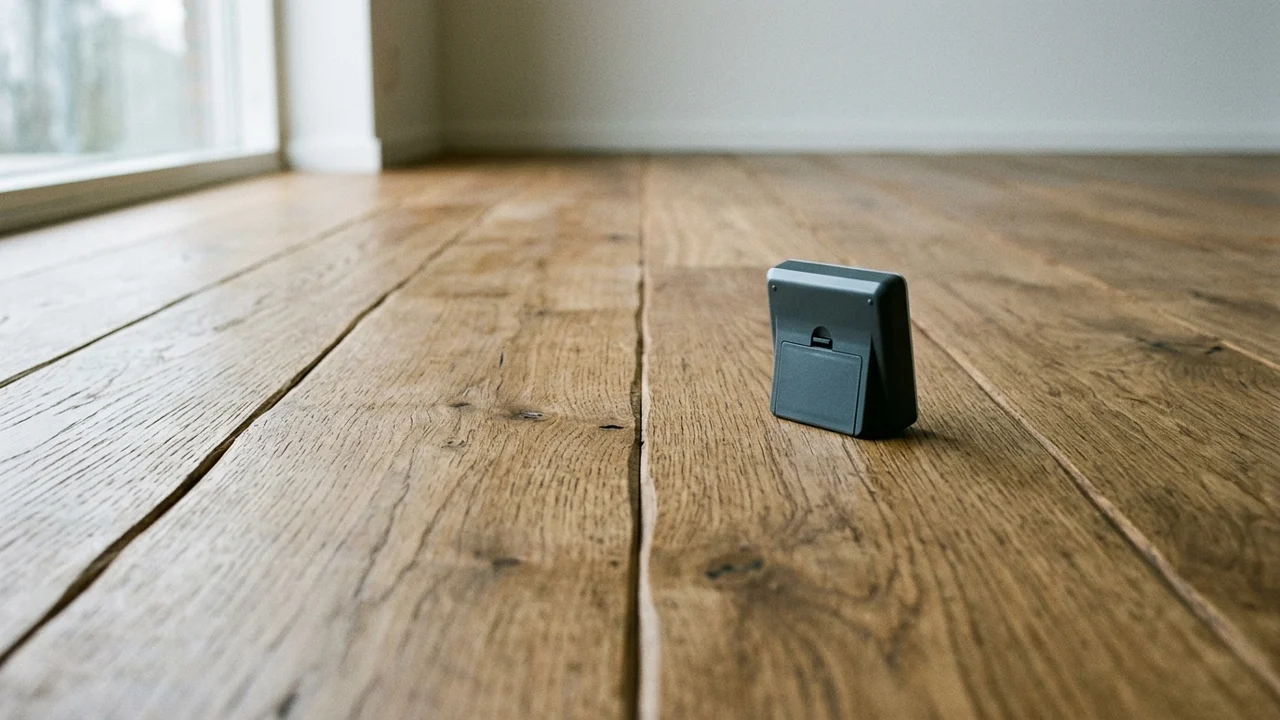
NWFA explains that wood can swell as it gains moisture and shrink as it loses moisture. It describes cupping as raised edges across the width of a board. That shape is useful to record; it does not, by itself, tell you whether the moisture came from indoor air, a leak or the layers below.
For bonded resilient flooring, INSTALL’s article identifies moisture and high pH as possible contributors to adhesive failure. A loose edge or bubble should therefore lead to checking the substrate and adhesive requirements, rather than simply choosing a thicker plank. It is still an observation requiring investigation, not proof of a particular cause.
Keep the moisture question separate from other movement problems. A raised joint alone is insufficient reason to specify a moisture-control coating. Have the installer assess other installation conditions as well. For an existing floating laminate floor with open joints, lifting or movement, use the laminate gaps and movement checks to record possible restraints, joint details and subfloor geometry.
Match the reading to the material and method
A percentage is incomplete without the measured quantity. Room RH, internal concrete RH and wood moisture content describe different conditions. Do not transfer a pass result between these rows or convert an emission-rate result to RH using a general calculator.
Scroll horizontally to view all columns.
| Measurement | What it describes | Record with the result | Where acceptance comes from |
|---|---|---|---|
| Room temperature and air RH | The indoor environment around the floor | Location, date/time, instrument and operating conditions | The selected floor’s environmental requirements |
| Wood-floor or wood-subfloor moisture content | Moisture in the wood material being measured | Material, meter, settings/corrections, locations and individual readings | Flooring instructions and applicable wood-floor guidance |
| In-situ concrete RH, ASTM F2170 | Relative humidity within the concrete slab | Method/edition, test report, locations, dates and test conditions | Documents for the selected flooring and adhesive system |
| Concrete moisture vapor emission rate, ASTM F1869 | Emission rate measured using anhydrous calcium chloride | Method/edition, complete units, locations and test conditions | Documents accepting that method for the specified system |
| Concrete surface pH | Acidity or alkalinity of the assessed surface | Method, locations, results and preparation conditions | Flooring, adhesive and preparation-product instructions |
ASTM’s public F2170-19a scope describes quantitative RH testing in concrete. Its significance section limits the result to the time and locations tested. The public F1869-23 scope describes a different test quantity: moisture vapor emission rate. These catalogue pages establish the distinction; they are not the complete test procedures.
NWFA’s installation guide also calls for appropriate meter settings and corrections when assessing wood substrates. Ask the person taking readings to identify what the instrument measures and how it was used. A number without that information cannot complete the acceptance record.
Read the floor and adhesive documents together
Start with the exact product and installation method: floating, glue-down or another specified assembly. The site’s vinyl flooring guide explains why a plank format does not establish its fixing method. Retrieve the instructions for the product actually installed or proposed, including their revision and territory.
Shaw’s SPC instructions, revision line 11052024, illustrate the boundary. They describe waterproof flooring while warning about excessive subfloor moisture. They prohibit installation over concrete with a history of high moisture or hydrostatic conditions. For glue-down work they direct the installer to the adhesive label for its moisture limits. Their concrete pH range is 7–10 for that documented system; it is not a limit for all floors.
Compare that with NWFA’s wood-floor guidance: the investigation includes room conditions and moisture in both wood flooring and substrate. A concrete test result alone does not fill those wood-related fields. Conversely, a wood meter reading does not satisfy a required concrete test.
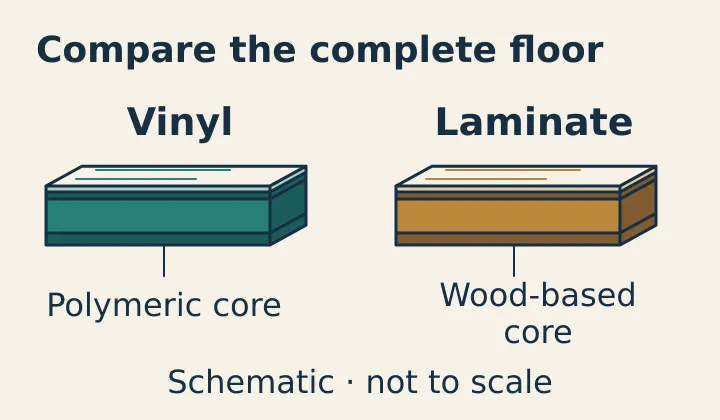
NALFA’s FAQ makes wet-area laminate suitability conditional on the manufacturer’s waterproof designation. That permission still needs the particular product’s instructions. Our vinyl and laminate comparison explains the difference between a bounded water claim and protection for the whole room.
If the flooring sheet and adhesive sheet disagree, leave acceptance open. Obtain a documented resolution for the proposed combination before installation. This guide deliberately supplies no class-wide RH or emission-rate cutoff: the system, method and acceptance document must stay together.
Use one investigation record per location and test
Copy this table into the job record, or download the blank flooring moisture record as CSV. The CSV contains the same investigation fields with blank entry cells. It contains no sample readings or automatic pass/fail calculation.
Scroll horizontally to view all columns.
| Field | Entry to make |
|---|---|
| Room and marked location | |
| Visible symptom and photograph reference | |
| First noticed; spill/leak or environmental history | |
| Surface water / room environment / substrate branch | |
| Existing floor: exact product and identification source | |
| Substrate material and known assembly | |
| Proposed floor and installation method | |
| Adhesive, underlayment and preparation products | |
| Room temperature/RH and operating conditions | |
| Test method and edition; instrument/report reference | |
| Test date/time and location | |
| Result and complete units | |
| Flooring acceptance limit and document/page/revision | |
| Adhesive acceptance limit and document/page/revision | |
| Other required checks, including pH where applicable | |
| Source correction or mitigation plan and responsible person | |
| Follow-up results and installation decision/date |
Leave an unknown entry blank until the relevant record or assessment exists. For example, identifying a proposed glue-down vinyl does not establish the adhesive: its name and limit-source fields remain blank until the adhesive is selected. Likewise, recording room RH fills the room-condition entry, not the concrete-test result.
Ask the installer to attach the full test report and the relevant pages of each acceptance document. A bare note saying “moisture passed” loses the method, units, location and product that make the result useful.
Decide what must be resolved before covering the substrate
Use the completed record to establish the next action, rather than choosing a replacement material first:
- Unresolved water source: arrange investigation and correction of the source before treating the replacement finish as the solution.
- Missing test or acceptance document: obtain the method, report or product requirements. A dry-looking floor is not a substitute.
- Result outside a documented limit: ask the installer and system manufacturers to resolve the preparation or mitigation specification and its compatibility. Do not select a coating solely from the symptom.
- Corrected conditions: document the follow-up assessment against the selected system’s requirements. NWFA cautions that concrete testing describes conditions at the time of testing, not permanent dryness.
There is no fixed number of drying days on this page. The decision requires the affected assembly, source correction and follow-up evidence. Suspected concealed damage also needs an appropriate site assessment; this record does not establish its extent.
Changing to a mineral finish also needs its own specification. If porcelain enters the replacement shortlist, the porcelain slab guide explains the material and format questions; confirm the exact product is suitable for the floor assembly. A wall-cladding specification does not provide floor approval or resolve the moisture source.
Once the substrate and floor system are accepted, use the flooring installation materials checklist to organise the matching supplies. Keep the completed investigation record with that checklist so an underlayment or adhesive substitution does not lose its acceptance basis.
Method and sources
Updated October 2026. We read the official NWFA, Shaw, NALFA and ASTM pages on 15 October 2026, including the NWFA PDF bearing a 2025 copyright. The ASTM references are the public scopes of the editions named above; we did not read their full paid procedures or represent them as the latest editions. Testing must follow the applicable complete procedure and project requirements.
The INSTALL article is dated October 2024 and was read from a complete archive retrieved on 11 October 2026; its live page blocked retrieval during this update. We excluded its industry-loss estimate. The source branches, blank record and decision sequence are editorial synthesis. We performed no site inspection, moisture testing, product ranking or repair trial.
Sources
- NWFA: Problem Prevention, moisture management — National Wood Flooring Association Accessed October 15, 2026.
- NWFA Wood Flooring Installation Guidelines, copyright 2025, Moisture Testing chapter — National Wood Flooring Association Accessed October 15, 2026.
- ASTM F2170-19a, public scope and significance for in-situ concrete RH — ASTM International Accessed October 15, 2026.
- ASTM F1869-23, public scope for concrete moisture vapor emission testing — ASTM International Accessed October 15, 2026.
- Shaw SPC installation guidelines, revision line 11052024 — Shaw Industries Accessed October 15, 2026.
- NALFA laminate flooring FAQs — North American Laminate Flooring Association Accessed October 15, 2026.
- Preventing Flooring Failures, October 2024; archived page retrieved October 2026 — INSTALL Floorcovering Professionals Accessed October 11, 2026.