Key takeaways
- The term covers several systems that behave differently, so name the one you mean.
- For composite panels, the core material is the fire decision.
- NFPA 285 evaluates the complete assembly, so a compliant panel does not make a compliant wall.
- Thermal movement is larger than in most cladding, and fixing design has to allow for it.
What it is
“Metal wall panel” is a family rather than a product. The systems within it differ enough that a specification naming only the family has not said much:
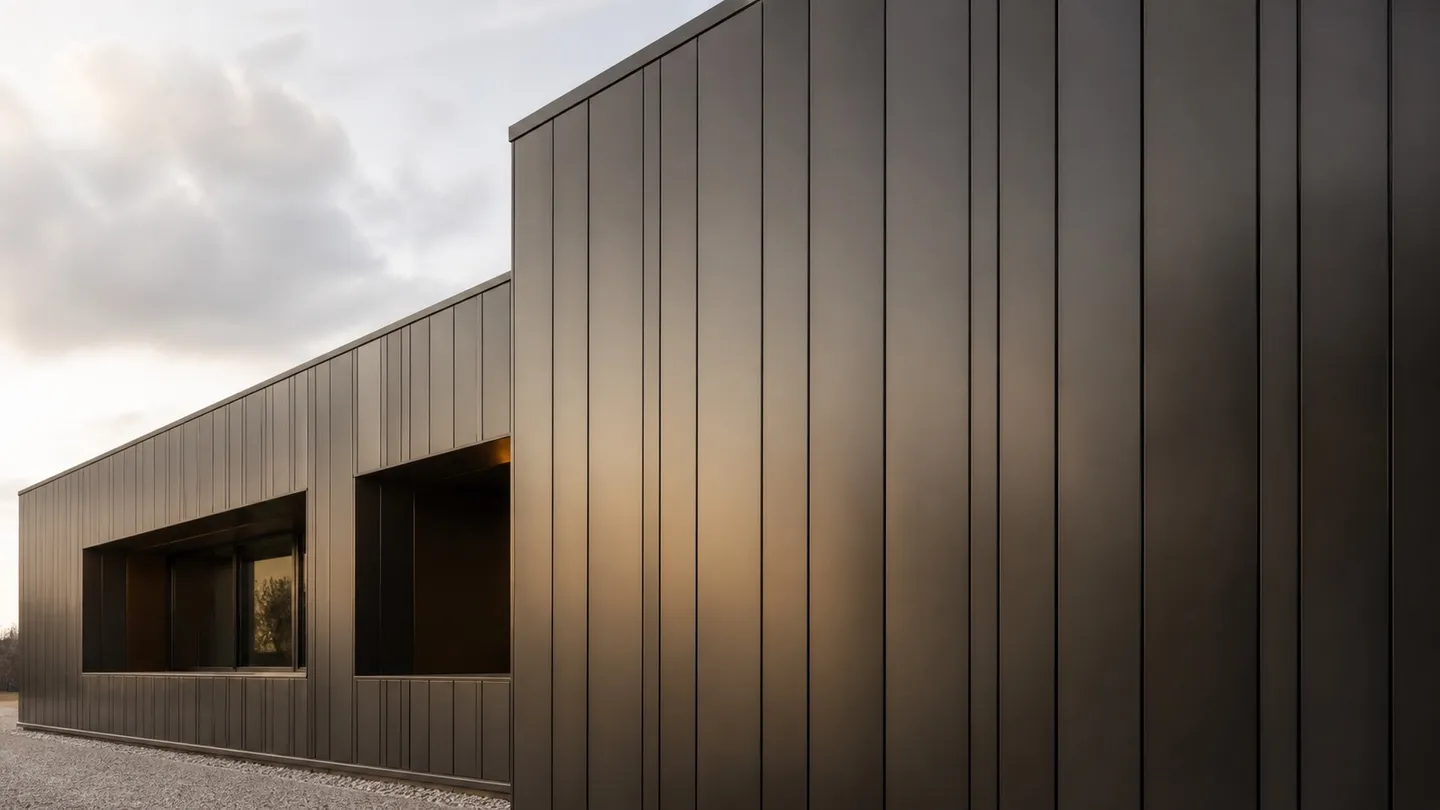
- Single-skin profiled sheet — formed metal fixed to a support structure.
- Cassette rainscreen — flat panels folded into trays, hung on a carrier system with open or gasketed joints.
- Aluminium composite material (ACM/MCM) — two thin metal skins bonded to a core.
- Insulated metal panels (IMP) — metal skins with a factory-applied insulating core.
The fire discussion below is mostly about the composite systems, because that is where the core material sits inside the wall.
The core decides the fire question
For composite panels the core is the single most consequential specification decision.
Polyethylene (PE) core is combustible. It does not pass NFPA 285, and it is prohibited in many jurisdictions for use above 40 ft on Type I and Type II buildings.
Fire-retardant (FR) core is mineral-filled and can pass NFPA 285 — but only when tested as part of a compliant assembly, and the result depends heavily on what else is in that assembly.
Mineral core contains no organic binder and is composed primarily of inorganic compounds, typically aluminium hydroxide. It achieves the highest classification and passes in the widest range of assembly configurations.
Why “the panel is rated” is the wrong sentence
NFPA 285 evaluates the performance of the entire exterior wall assembly, not the panel on its own. Insulation type, cavity depth, the water-resistive barrier, the attachment system and joint detailing may all influence whether the finished facade satisfies the requirement.
The practical consequence: a manufacturer’s NFPA 285 listing applies to the assembly configurations that were tested. Substituting the insulation, changing the cavity or altering the attachment can put the wall outside what was tested, even with the same panel.
Common formats
Panel size, joint type and attachment method vary by system. Cassette rainscreen and open-joint systems deliberately admit some water and rely on the drainage plane behind, which changes what the water-resistive barrier has to do compared with a sealed system.
What governs performance
Thermal movement is larger than in most cladding. Panel size, span and fixing type all have to accommodate it; oil-canning and fastener distress are the usual signs it was not allowed for.
Metal selection governs corrosion behaviour. Coastal and industrial exposures, and any contact between dissimilar metals, need to be resolved at design stage.
Finish — architectural fluoropolymer coatings and polyester systems have different warranty and fade profiles. Ask for the coating warranty separately from the panel warranty.
Advantages
Long spans, large formats and precise lines. Low water absorption and no rot or insect concerns. On a rainscreen the system is drained and back-ventilated by design.
Limitations
Fire compliance is an assembly exercise with real cost and real substitution risk. Thermal movement constrains panel size. Denting and oil-canning are appearance issues that appear on site rather than in a sample. And the specification burden is higher than for Fiber Cement Cladding, because more of the outcome depends on components you are not looking at.
Installation overview
Support structure and carrier system, water-resistive barrier and drainage plane, panel attachment following the tested configuration, then joints and terminations. Where NFPA 285 compliance is required, the installed build-up has to match a tested assembly — that check happens before procurement, not after.
Maintenance
Washing per the coating manufacturer, plus inspection of joints, gaskets and fixings. Coating failure and fastener corrosion are the two things worth looking for.
Selection checklist
- Which system is specified — profiled sheet, cassette, composite or insulated panel?
- For composites, what is the core, and is it PE, FR or mineral?
- Is there an NFPA 285 tested assembly that matches the actual build-up, including insulation and cavity?
- Has thermal movement been allowed for at the specified panel size?
- Is the metal appropriate for the exposure, and are dissimilar-metal contacts resolved?
For the direct comparison, see Fiber Cement vs Metal Cladding, see how metal assemblies fit into exterior wall specifications, and for the rest of the family, browse wall cladding.
Key performance characteristics
| Property | Typical range | Basis |
|---|---|---|
| Assembly fire test | NFPA 285 evaluates the complete exterior wall assembly rather than the panel alone Insulation, cavity depth, water-resistive barrier, attachment and joints all affect the result. | NFPA 285 scope |
| Polyethylene-core composite | combustible; does not pass NFPA 285 and is restricted in many jurisdictions above 40 ft on Type I and II buildings | — |
| Fire-retardant and mineral core | can pass NFPA 285 when tested as part of a compliant assembly; mineral core passes in the widest range of configurations | — |
| Base metals | aluminium, coated steel, zinc and copper; corrosion behaviour varies by metal and exposure | — |
| Thermal movement | greater than most cladding materials; confirm the manufacturer's allowance for panel size and span | — |
Ranges are indicative and vary by product formulation, grade and thickness. Confirm values against the current manufacturer documentation for the product actually being supplied, and verify the applicable local codes.
Compared with alternatives
- Fiber Cement vs Metal Cladding Fiber cement and metal cladding compared on standards, fire compliance, site handling, thermal movement and the maintenance cycle each one commits you to.
Frequently asked questions
Does a panel that passes NFPA 285 make the wall compliant?
No. NFPA 285 is a test of the complete exterior wall assembly. Insulation type, cavity depth, the water-resistive barrier, the attachment system and joint detailing all affect the outcome, so compliance belongs to a tested assembly rather than to a panel.
What is the difference between PE, FR and mineral core?
Polyethylene core is combustible and does not pass NFPA 285. Fire-retardant core is mineral-filled and can pass as part of a compliant assembly. Mineral core contains no organic binder and passes across the widest range of assembly configurations.
Sources
- IBC — Metal Composite Materials (MCM): core requirements and height limits (code text) — UpCodes Accessed August 28, 2026.
- IBC — Vertical and lateral flame propagation: where NFPA 285 is required (code text) — UpCodes Accessed August 28, 2026.
- NFPA 285 — Standard Fire Test Method for Exterior Wall Assemblies (scope) — National Fire Protection Association Accessed August 28, 2026.