Key takeaways
- ASTM C1186 covers flat fiber-cement sheets for cladding, facades and soffits.
- Cutting releases respirable crystalline silica; OSHA prescribes specific controls.
- It is dimensionally stable but not waterproof — the assembly behind it still manages water.
- Factory-finished and site-finished products have very different maintenance profiles.
What it is
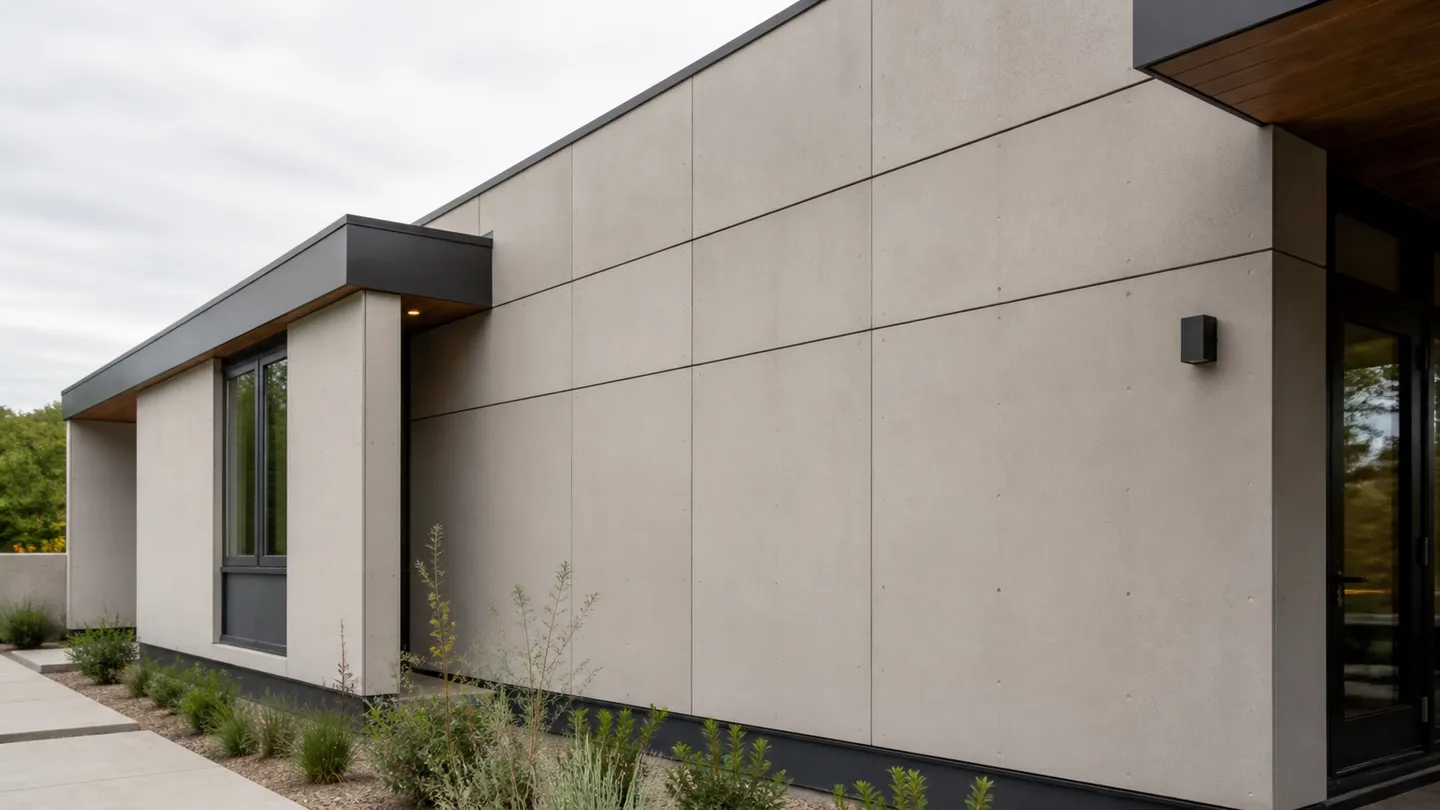
Fiber cement cladding is a composite of portland cement, cellulose fibre, sand and water, formed into sheets or planks and cured. Modern formulations are non-asbestos; the material’s earlier history is the reason that qualifier still appears in standard titles.
ASTM C1186 is the product standard for flat fiber-cement sheets, and its scope names exactly the applications this page is about: claddings, facades, curtain walls and soffits.
The site hazard that defines how it is handled
Fiber cement contains crystalline silica. Cutting it with a power saw generates fine respirable dust, and this is a regulated exposure rather than general construction dirt.
NIOSH sets a recommended exposure limit of 0.05 mg/m³ for respirable crystalline silica and has measured uncontrolled fiber-cement cutting at up to 3.4 times that level. OSHA updated its construction silica rule in 2016 and provides a specific control for cutting fiber cement board with a handheld power saw of 8 in blade diameter or less; where that control is fully and properly implemented, respirators and additional exposure monitoring are not required. NIOSH’s own testing found that a regular shop vacuum attached to the saw brought airborne dust well below the recommended limit.
This matters at specification stage, not just on site: it affects whether cutting happens in a controlled area, what the trade needs, and whether factory-cut or pre-finished product is worth the premium.
Common formats
Flat sheets for panel systems, planks for lap installation, and dedicated soffit boards. Products arrive either primed for site finishing or factory-finished, and that choice drives most of the maintenance difference between otherwise similar installations.
What governs performance
The material is dimensionally stable and does not rot, but it is not a barrier. Water reaching the back of the cladding still has to drain and dry, which is why battened rainscreen installation is common and why fixing over damp unvented masonry is a poor idea.
Edge and cut-end treatment is the detail that separates good installations from ones that stain. Cut edges expose the substrate and, on site-finished product, need sealing per the manufacturer.
Advantages
It holds paint and factory finishes well, resists insects and rot, and is dimensionally stable across temperature swings in a way that timber and some polymer products are not. Cost sits between timber and the metal and porcelain options in this family.
Limitations
It is heavy to handle in sheet form and brittle at edges before fixing. Cutting is a controlled operation. Site-finished product needs repainting on a cycle, so the maintenance comparison against Metal Wall Panels depends heavily on which finish route was chosen.
Installation overview
Water-resistive barrier and drainage provision first, then battens where a ventilated cavity is used, then boards fixed to the manufacturer’s pattern with the specified fastener type and edge distances. Joints, corners and terminations follow the manufacturer’s details — these are the locations where water enters when they are improvised.
Maintenance
Factory-finished product is generally washed and inspected. Site-finished product enters a repainting cycle set by the coating rather than by the substrate. Both need the same periodic check of joints, sealant and flashing.
Selection checklist
- Is ASTM C1186 referenced, and is the product within its scope for this application?
- Is the cutting method and dust control specified, with the OSHA control identified?
- Is there a drainage provision and a water-resistive barrier behind the cladding?
- Factory-finished or site-finished, and has the maintenance cycle been priced accordingly?
- Are cut-edge sealing requirements from the manufacturer in the specification?
Compare against the metal alternative in Fiber Cement vs Metal Cladding, explore how it performs among the best materials for exterior walls, and see the family overview for where it sits among the alternatives.
Key performance characteristics
| Property | Typical range | Basis |
|---|---|---|
| Product standard | ASTM C1186 for flat fiber-cement sheets used as cladding, facades and soffits | ASTM C1186 scope |
| Composition | portland cement, cellulose fibre, sand and water; non-asbestos formulations | — |
| Respirable crystalline silica — NIOSH REL | 0.05 mg/m³, with uncontrolled cutting measured at up to 3.4 times that level This is an exposure limit for workers, not a property of the finished wall. | NIOSH Workplace Solutions 2015-185 |
| Dust control on site | OSHA provides a specific control for handheld saws with blades no greater than 8 in | OSHA respirable crystalline silica standard for construction |
| Fire behaviour | cement-based and not readily combustible, but classification applies to the tested assembly | — |
Ranges are indicative and vary by product formulation, grade and thickness. Confirm values against the current manufacturer documentation for the product actually being supplied, and verify the applicable local codes.
Compared with alternatives
- Fiber Cement vs Metal Cladding Fiber cement and metal cladding compared on standards, fire compliance, site handling, thermal movement and the maintenance cycle each one commits you to.
Frequently asked questions
Is cutting fiber cement cladding a health hazard?
Cutting releases respirable crystalline silica. NIOSH sets a recommended exposure limit of 0.05 mg/m³ and has measured uncontrolled cutting at up to 3.4 times that level. OSHA prescribes controls, and a shop vacuum on the saw has been shown to bring levels well below the limit.
Does fiber cement cladding waterproof a wall?
No. It is a weather-exposed finish, not a barrier. The water-resistive barrier, drainage and flashing behind it do the waterproofing.
Sources
- ASTM C1186 — Standard Specification for Flat Fiber-Cement Sheets — ASTM International Accessed August 28, 2026.
- Reducing Hazardous Dust Exposure When Cutting Fiber-Cement Siding (Workplace Solutions 2015-185) — NIOSH Accessed August 28, 2026.
- OSHA's Respirable Crystalline Silica Standard for Construction — OSHA Accessed August 28, 2026.