Key takeaways
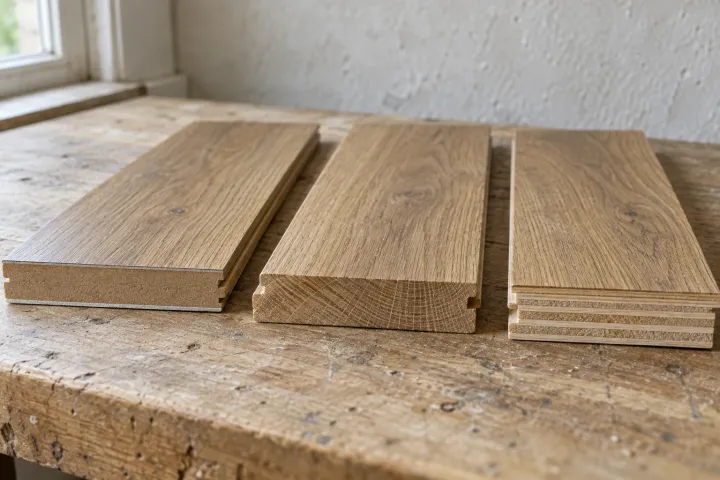
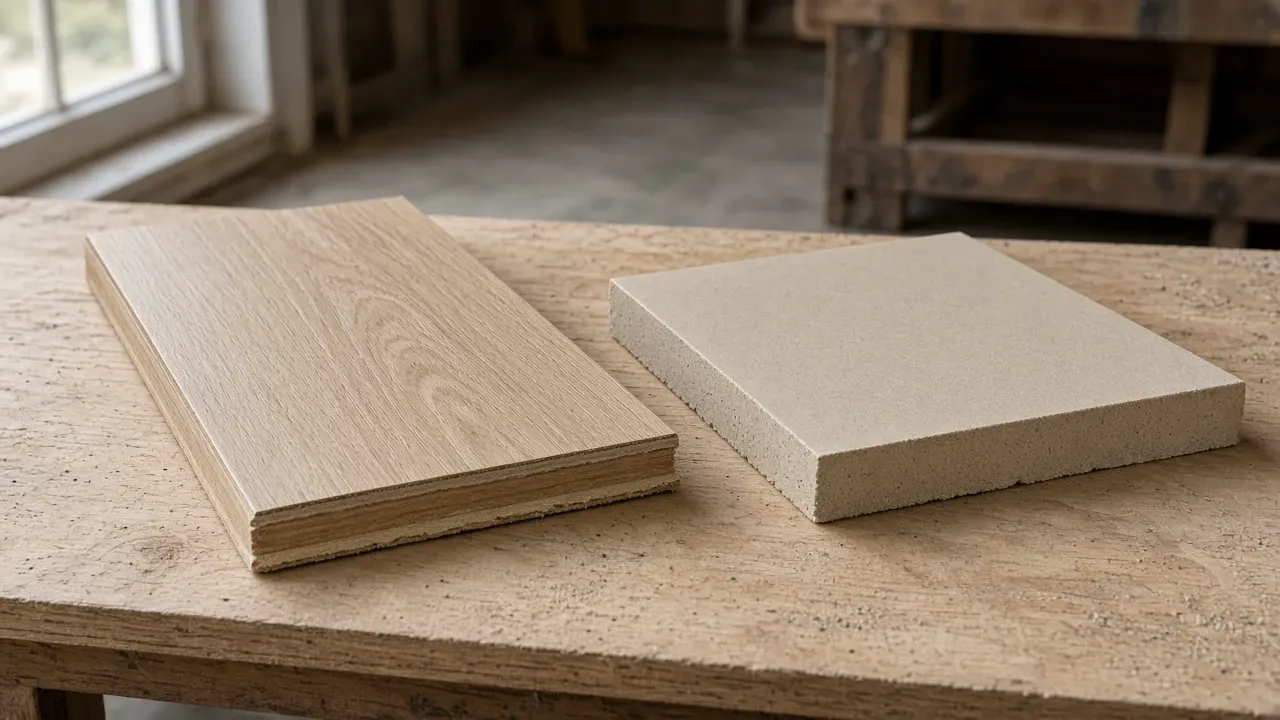
- A wood-look or stone-look face does not tell you whether the floor is vinyl or fired tile. Record the construction and the fixing method.
- Shaw's COREtec SPC sheet, revision line 11052024, is one rigid-core example. Its flatness, gap and moisture figures do not transfer to other vinyl products or to tile.
- TCNA's public FAQ says every tile installation needs room to move. This page did not read Handbook detail EJ171, so it does not quote a spacing.
- A waterproof claim on a vinyl face still leaves the subfloor moisture test, and the product's own wet-area wording, in place.
- Fill one sheet for the room: subfloor, documents, movement, moisture and repair. Leave a cell blank when the document is silent.
At a glance
Scroll horizontally to view all columns.
| Criterion | Vinyl flooring | Ceramic and porcelain floor tile |
|---|---|---|
| What you are buying | A resilient covering in plank, tile or sheet, with its own core and fixing method | A fired tile set in mortar, with grout joints and separate movement joints |
| Subfloor | Clean, flat, dry and sound, to the flatness limit in that product's sheet | A substrate prepared for the mortar, membrane and tile you will use |
| Movement | A perimeter gap from the installation sheet; floating trim stays unfastened to the planks | A perimeter gap in a small room; visible movement joints in a larger area |
| Water | A face claim still leaves the subfloor moisture test and the written wet-area wording | The tile body and the grout are different paths for water |
| Repair | The replacement instruction for that SKU; floating and glue-down are different jobs | Matching tile, setting material, grout, and any movement joint in the damaged area |
| Evidence to request | Dated installation instructions and warranty for the exact product | Setting, grout and movement-joint documents for the installation |
A vinyl floor that copies a tile look can still be damaged by subfloor moisture or a missing gap, and a tile floor can crack when the room has no movement joint. Compare how each floor is built and fixed. Vinyl limits come from that product’s documents. Ceramic and porcelain tile need joints because the tile and the substrate move differently. This page is a two-route sheet for one indoor room.
Use the sheet on the existing subfloor, the installation and warranty documents, the movement detail and the repair method. Shaw’s COREtec SPC guidelines, revision line 11052024, are one rigid-core example read on 11 October 2026, not a limit for every vinyl floor. The Tile Council of North America’s public Placement FAQ, read the same day, says every tile installation needs room to move and points to Handbook detail EJ171 for spacing. This page did not read EJ171.
What should you record before comparing vinyl and tile?
Five records decide the comparison. A loose sample does not.
Scroll horizontally to view all columns.
| Input | Where to get it | Why it matters |
|---|---|---|
| Existing subfloor | The room: wood, concrete, or a hard floor already in place | Vinyl and tile instructions start from different bases |
| Flatness | The product’s installation sheet, then a check of this room | A limit from one product does not transfer to the other |
| Movement | Vinyl: the perimeter gap in the installation sheet. Tile: the project movement-joint detail | A locked plank and a grouted tile move differently |
| Moisture | The test named by the product and the adhesive, with the result and the date | A waterproof face claim does not replace that test |
| Repair | The replacement instruction for that product, plus spare material | Floating vinyl, glue-down vinyl and set tile are different repairs |
Takeaway: Fill these five lines for each real candidate before you compare finishes.
How do the material and the installed system differ?
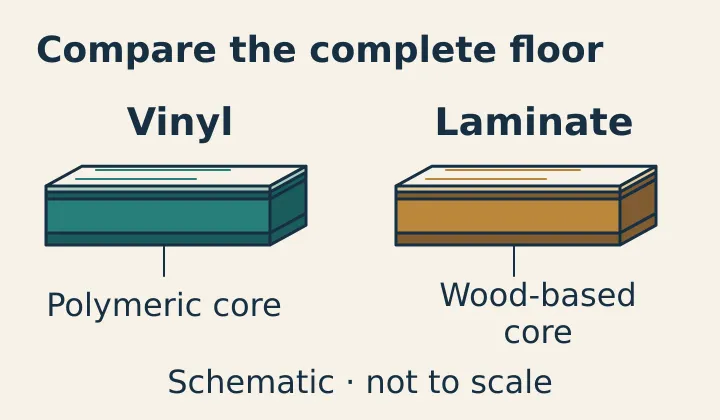
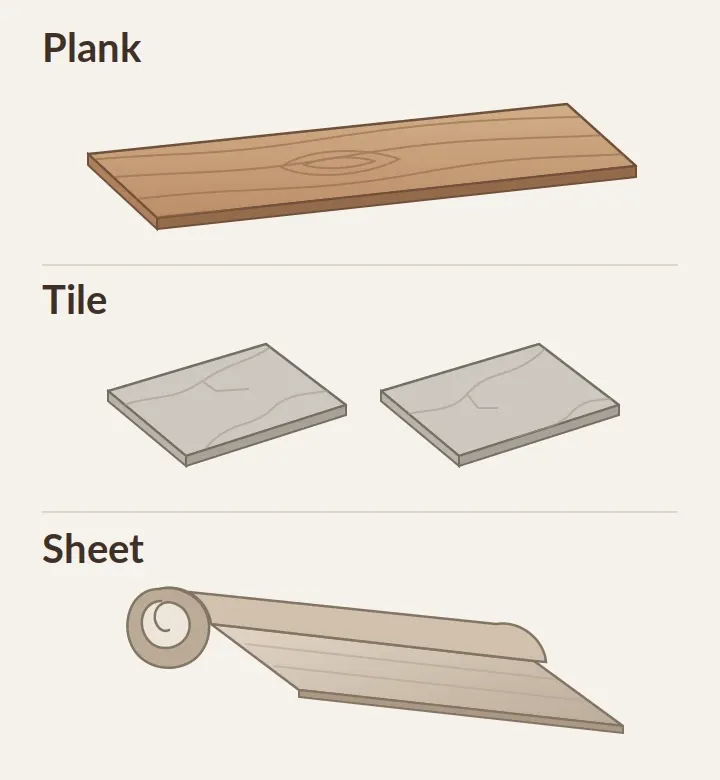
Vinyl flooring in this comparison is a resilient floor covering. Ceramic and porcelain tile are fired tile set as a floor. A vinyl product can be a plank or a tile. That vinyl tile is still vinyl. The guide to vinyl plank, tile and sheet formats separates those formats from flexible and rigid-core construction.
The Resilient Floor Covering Institute, on its flooring-types page read 11 October 2026, describes luxury vinyl tile as flexible resilient flooring produced as tiles or planks. It describes rigid-core flooring as modular flooring with a rigid polymeric core, a decorative surface and an optional attached underlay, also made as tiles or planks. That is a category description. It is not a test result for a named floor.
Ceramic and porcelain tile are a different assembly. TCNA’s public Placement FAQ calls tile a facade. Movement joints relieve stress when the tile and the substrate expand and contract by different amounts. The FAQ says the TCNA Handbook recommends that allowance in every tile installation, and that placement guidelines are in Detail EJ171. The handbook was not part of this reading, so no spacing from EJ171 appears below.
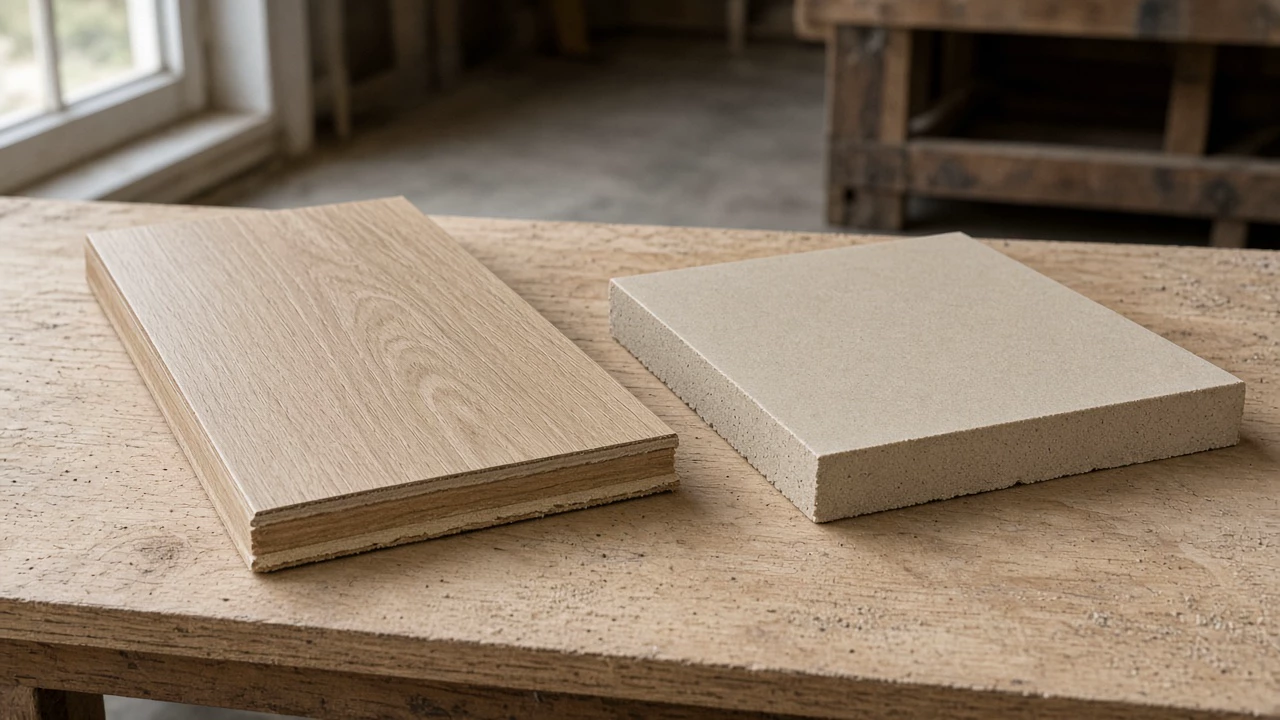
One published rigid-core sheet shows how specific the vinyl side gets. Shaw Industries’ COREtec SPC installation guidelines, revision line 11052024, approve floating and glue-down installation, on, above or below grade. The sheet says the plank is designed for the floating method. Glue-down is also approved: into wet adhesive, then rolled with a 100 lb three-section roller. Recommended adhesives on that sheet are 2200, 4200, 200 and 1500, or an equivalent after a bond test. Those instructions belong to that SPC document.
Takeaway: Write the format, the core and the fixing method on separate lines. A wood-look face fills none of them.
Which subfloor checks are not interchangeable?
Both floors need a sound base. The checks differ.
Shaw’s SPC sheet requires every subfloor to be clean, flat, dry and structurally sound. The flatness it states is 3/16 inch in 10 feet, or 1/8 inch in 6 feet. It rejects carpet, wood subfloors that lie directly on concrete, and wood floors adhered to concrete. It says not to lay sheet plastic over wood subfloors. Over existing ceramic or porcelain, it allows grout joints up to 1/4 inch wide. Wider joints need a cementitious patch filled flush with the tile. Crumb-rubber underlayment is rejected. A second underlayment under a product that already has an attached pad is limited, in residential use, to 3 mm.
Those figures are from that one sheet, read on 11 October 2026. Another vinyl product can set different flatness, moisture and underlay rules. Copy the numbers from the sheet for the product you will buy.
For concrete, the same sheet points to ACI 302 and ASTM F710. Its moisture sentence sets 8 lb for the ASTM 1869 calcium chloride test and 90 percent for ASTM 2170 in-situ relative humidity, and it adds “per 1,000 sq ft in 24 hours.” That unit is how the calcium chloride method is reported. Relative humidity is a percentage in the slab. The sheet also states a concrete pH of 7 to 10. Shaw writes that it does not warrant damage from moisture-related issues, and that the installer must confirm the tests were run and were acceptable. A test describes the slab at the time of the test.
This page has no matching public flatness number for ceramic or porcelain tile. Use the flatness, deflection and preparation limits in the tile, mortar and membrane instructions for your installation. Do not paste the Shaw 3/16 inch figure into a tile specification.
INSTALL’s article of 18 October 2024, by David Gross and first published in the May 2024 Construction Specifier, says substrate preparation should include moisture and pH, and that missing those limits can void a manufacturer’s warranty. For vinyl it names adhesive failure, telegraphing of subfloor flaws, bubbling or blistering, and discoloration from high alkalinity. The article cites Independent Floor Testing & Inspection for a figure of $2.4 billion a year in moisture-related remediation, and calls moisture the leading cause of flooring failures. That dollar figure is IFTI’s, as quoted by INSTALL. This guide did not audit the underlying count.
INSTALL names the in-situ relative humidity test as ASTM F2170. For calcium chloride it quotes the standard title for measuring moisture vapor emission with anhydrous calcium chloride, and the designation is printed on that page as “ASTM Fl 869”, the F1869 method. Those are the tests Shaw’s sheet abbreviates as ASTM 1869 and ASTM 2170. For pH it describes the ASTM F710 check used when preparing concrete for resilient flooring: several drops of distilled or deionized water in about a 1 inch (25 mm) circle, then a strip reading after 60 seconds, plus or minus 5 seconds, repeated in more than one place. The acceptable range still comes from the floor and the adhesive. Shaw’s 7 to 10 is that SPC sheet’s range.
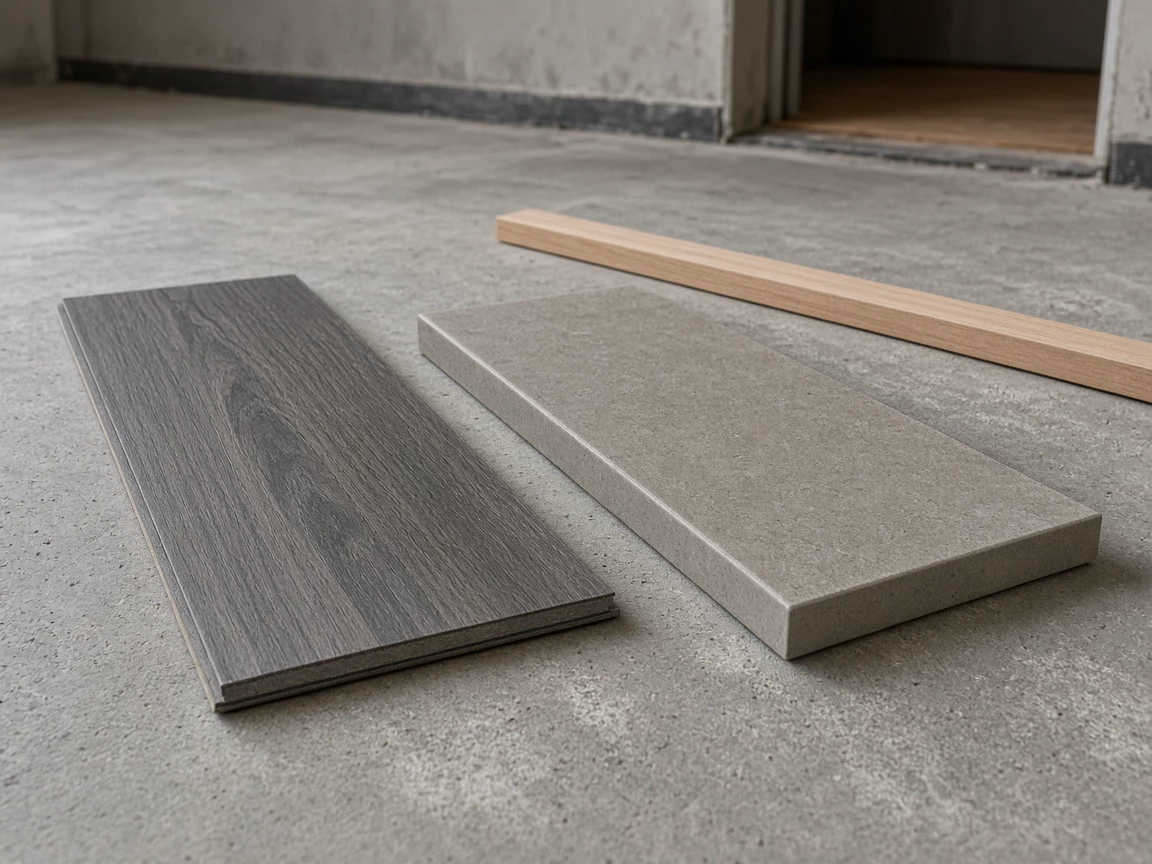
Takeaway: Record the test name, the result, the date and the limit printed for the product and adhesive you will actually use.
How does each floor make room for movement?
Shaw’s SPC sheet sets a perimeter gap of 1/4 inch where the area is under 2,500 square feet, and 1/2 inch where the area is larger, for floating or glue-down. The floating steps also call for 1/4 inch (6.35 mm) at the perimeter. Both statements are in the sheet, so use the rule that matches your area. Wall moldings and transition strips must not be fastened to floating planks. The sheet says excess heat from direct sunlight can cause thermal expansion and fading, and it recommends blinds at peak sun.
If cabinets, including islands, will sit on this SPC floor, that footprint must be fully adhered, plus 2 feet beyond the cabinets. That is a glued zone inside a floor the sheet otherwise treats as floating.
For rooms left without climate control for long parts of the year, the sheet allows a post-installation range of -25°F to 155°F for floating floors only. Glue-down does not receive that allowance. The sheet also prints a Celsius pair beside those Fahrenheit figures that does not match them, so this page cites the Fahrenheit range only. Installation itself is specified in a controlled room at 55°F to 85°F (13°C to 29°C), or an average of 70°F (21.1°C). This sheet does not require acclimation. Another vinyl product can.
Radiant heat, in this Shaw sheet, needs at least 1/2 inch between the heating components and the flooring. The system runs for at least two weeks before installation. Three days before, the temperature is lowered to 65°F. After installation it rises in 5°F steps, and the operating temperature should stay at or below 85°F. An in-floor sensor is recommended. Those steps are for this SPC document. Tile and mortar over radiant heat need the tile and heating-system limits. This page does not supply them.
TCNA’s public FAQ says a small room can often use a perimeter gap, frequently hidden by baseboard or shoe molding. In a larger area the movement joints are visible. TCNA says it will not specify the exact location or frequency, because site conditions differ, and it points readers to Detail EJ171. Interior joints are placed more often where moisture or direct sunlight is expected. No EJ171 spacing is quoted here.
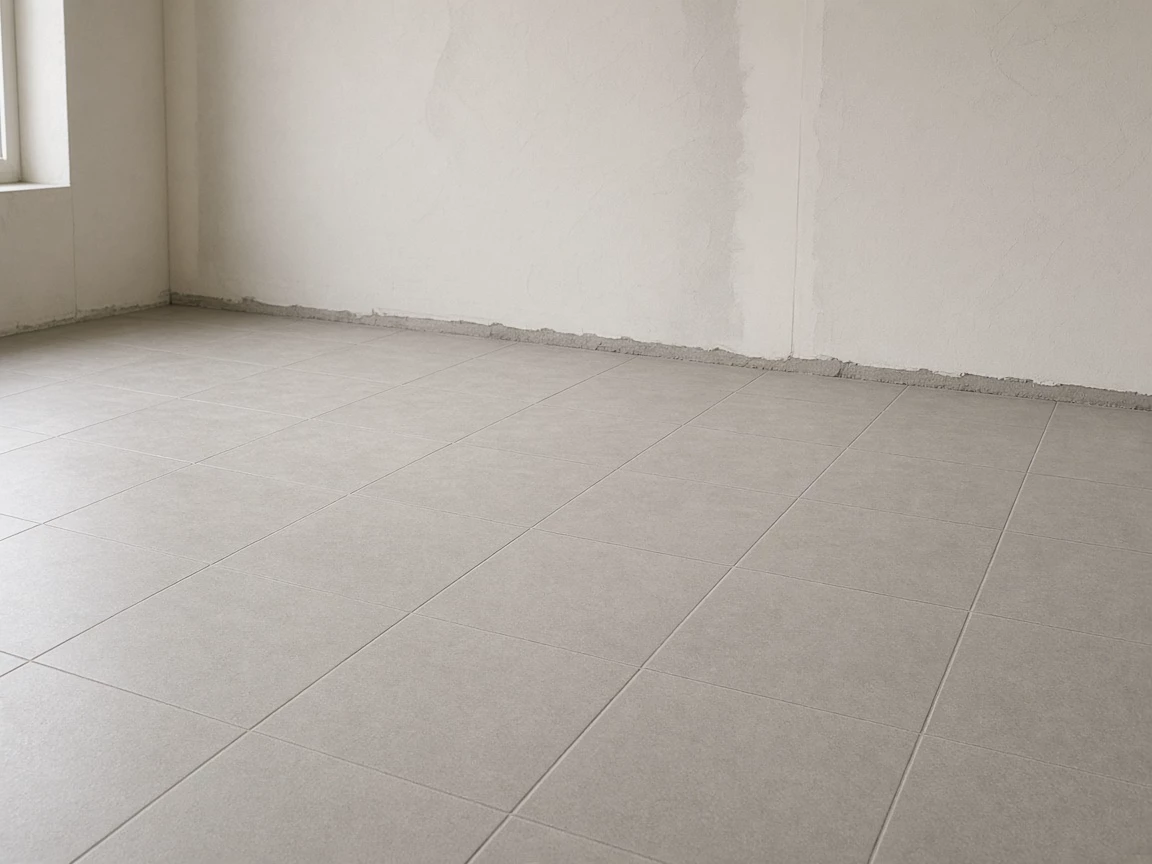
Common mistake: Treating every joint as grout. Confirm which lines are movement joints before they are filled. The TCNA FAQ says those joints relieve stress between the tile and the substrate. The sealant itself comes from the project detail, not from this page.
Takeaway: Write the gap the vinyl sheet requires for your area, and the tile detail that sizes the movement joints. “EJ171, not read” is an honest tile entry until you have the handbook detail.
Where does a waterproof claim stop?
Shaw’s SPC sheet says the flooring is waterproof and that the panels lock on all four sides. The following sentences limit that sentence. Excessive moisture in the subfloor can still promote mold, mildew and trapped vapor. Shaw does not warrant moisture-related damage. In wet areas such as bathrooms, the sheet says to caulk the perimeter with flexible silicone. That is a perimeter detail for this product. It does not specify a shower, a floor drain or standing water.
A waterproof face still leaves the subfloor moisture test in place.
INSTALL’s vinyl list (adhesive failure, telegraphing, bubbling, discoloration) is the failure set you are checking for when you match a test result to the product and the adhesive. The pass limit is the one printed for your adhesive and your floor. It can be tighter than the Shaw SPC figures.
For tile, water can remain in grout joints when the tile body itself is dense. This page has no grout-sealing schedule and no absorption class for porcelain as a category. If the room sees regular water, ask for the tile’s absorption classification and the grout manufacturer’s wet-area instructions.
Takeaway: Write the exposure the document covers, such as ordinary spills or a caulked bathroom perimeter. Leave the cell blank when the document is silent.
What can you replace later?
The Shaw sheet read for this page is an installation document. It does not give a plank-replacement sequence. It does say claims will not be accepted for flooring that has been cut to size and installed, and that gaps can compromise the locking system. The repair method has to come from a repair instruction for that SKU.
The fixing method changes the job. A floating SPC floor is not fastened to the subfloor, and the trim is not fastened to the planks. A glue-down floor is set into wet adhesive for a permanent bond and rolled with a 100 lb roller. Replacing one piece differs in those two systems. Get the written method, and keep spare planks from the same product when the method depends on a match.
The public TCNA FAQ does not describe single-tile replacement. The repair scope to confirm is the matching tile, the setting material, the grout, and whether the damaged line is a movement joint. The FAQ treats that joint as part of every tile installation. Replacing a cracked tile without identifying the joint leaves the movement question open.
Takeaway: Buy with a written replacement method and spare material. An installation sheet alone does not prove that one piece can be swapped later.
What goes on the two-route sheet for one room?
Use one row per check. “Not supplied” is a valid entry. The last column says where a requirement comes from.
On a narrow screen, swipe the table sideways to read the final column.
Scroll horizontally to view all columns.
| Check | Vinyl column | Tile column | Basis |
|---|---|---|---|
| Subfloor and flatness | The product’s limit, then the room measurement | Mortar and membrane limits, then the room measurement | Shaw SPC sheet for one vinyl example; tile limits from your documents |
| Existing floor | Allowed or rejected by the vinyl sheet, including grout-joint width if vinyl would cover tile | Whether that floor stays or comes out | Shaw SPC sheet on existing ceramic; the tile scope is yours |
| Movement | Perimeter gap for the area, and whether trim or cabinets pin the floor | Perimeter or field joints, and the detail that sizes them | Shaw SPC sheet; TCNA public FAQ. EJ171 was not read |
| Moisture and pH | Test name, result, date, and the product and adhesive limit | The limit in the setting-material instructions | Shaw SPC figures only for that sheet; INSTALL names the test methods |
| Repair | Floating or glue-down, the replacement instruction, and spare planks | Tile, mortar, grout, and any movement joint | A checklist. The Shaw sheet has no replacement sequence |
| Room exposure | What the installation sheet and warranty include and exclude | What the tile and grout documents include | The product documents. This page does not rank rooms |
Compare the completed columns. A lower material price does not close an empty moisture or movement cell. This guide does not quote prices.
Takeaway: Choose the candidate whose documents match the room and the repair you expect. Resolve every “not supplied” line first.
When this does not apply
Stop and get a different document when any of these is true:
- The choice is an exterior wall or a porcelain slab used as cladding. This page is an interior floor comparison.
- The room has a shower, a floor drain or standing water, unless both assemblies’ documents cover that exposure in writing.
- Someone needs to remove old resilient flooring. Shaw’s sheet warns that sanding, dry sweeping, drilling or pulverizing existing resilient flooring, its backing, or cutback adhesive can release asbestos or crystalline silica, and it points to RFCI’s recommended work practices. This page is not a removal procedure.
- A radiant-heat schedule from the Shaw SPC sheet is being copied onto a tile installation. Use the tile and heating-system documents.
- The room is unconditioned for part of the year, unless the product you buy states a range for that condition. The -25°F to 155°F range above is the floating allowance in that Shaw sheet only.
Method and sources
The vinyl numbers come from Shaw Industries’ COREtec SPC installation guidelines, revision line 11052024, read on 11 October 2026. They apply to that instruction, not to vinyl as a class. The tile movement statements come from TCNA’s public Placement FAQ, read the same day. Handbook detail EJ171 was not read. Moisture-failure modes, the ASTM F710 pH description, and the $2.4 billion remediation figure come from INSTALL’s 18 October 2024 article, which quotes David Gross in the May 2024 Construction Specifier and cites IFTI. This page did not re-calculate that figure. Flexible LVT and rigid-core wording comes from RFCI’s flooring-types page, also read on 11 October 2026. Manufacturer and association pages are not a building code. The instructions for the product you buy take precedence.
The FAQ titles on differences, wet vinyl and bathrooms are People Also Ask questions from the US desktop results for “vinyl flooring vs tiles” collected on 11 October 2026. The cost question is this page’s form of the related search “vinyl flooring vs tiles price”. No prices are published. No product named here is endorsed or ranked. We did not test or install any floor.
Frequently asked questions
What are the key differences between vinyl flooring and tile flooring?
Vinyl is a resilient covering. Its flatness, gap, moisture and repair rules come from that product's documents. Ceramic and porcelain tile are a set assembly: the Tile Council of North America describes tile as a facade that needs movement joints because the tile and the substrate move differently. A vinyl tile is still vinyl, not ceramic.
What happens if vinyl flooring gets wet?
Water on the face and water under the floor are different cases. Shaw's COREtec SPC sheet, revision line 11052024, calls that flooring waterproof, then says excessive subfloor moisture can still trap vapor and is not warranted. INSTALL lists adhesive failure, telegraphing, bubbling and alkali discoloration as vinyl moisture problems. Read the exclusions for the product you would buy.
Is vinyl flooring good for bathrooms?
Only when that product's documents cover the bathroom you have. The same Shaw SPC sheet tells the installer to caulk the perimeter with flexible silicone in wet areas such as bathrooms. It does not describe a shower or a floor drain. Tile in a wet room needs its own mortar, grout and movement-joint documents.
How should you compare vinyl flooring and tile costs?
Compare the whole scope for the same room. List subfloor preparation, removal of the existing floor, underlay or mortar and grout, transitions, and the future repair route. A material price leaves those lines out. This guide does not quote prices.
Sources
- COREtec SPC installation guidelines, revision line 11052024 — Shaw Industries Accessed October 11, 2026.
- Placement FAQ: why movement joints are needed and where they go — Tile Council of North America (TCNA) Accessed October 11, 2026.
- Preventing Flooring Failures, 18 October 2024 — INSTALL Floorcovering Professionals Accessed October 11, 2026.
- Resilient flooring types — Resilient Floor Covering Institute (RFCI) Accessed October 11, 2026.